Grand Prix du roman de l'Académie française
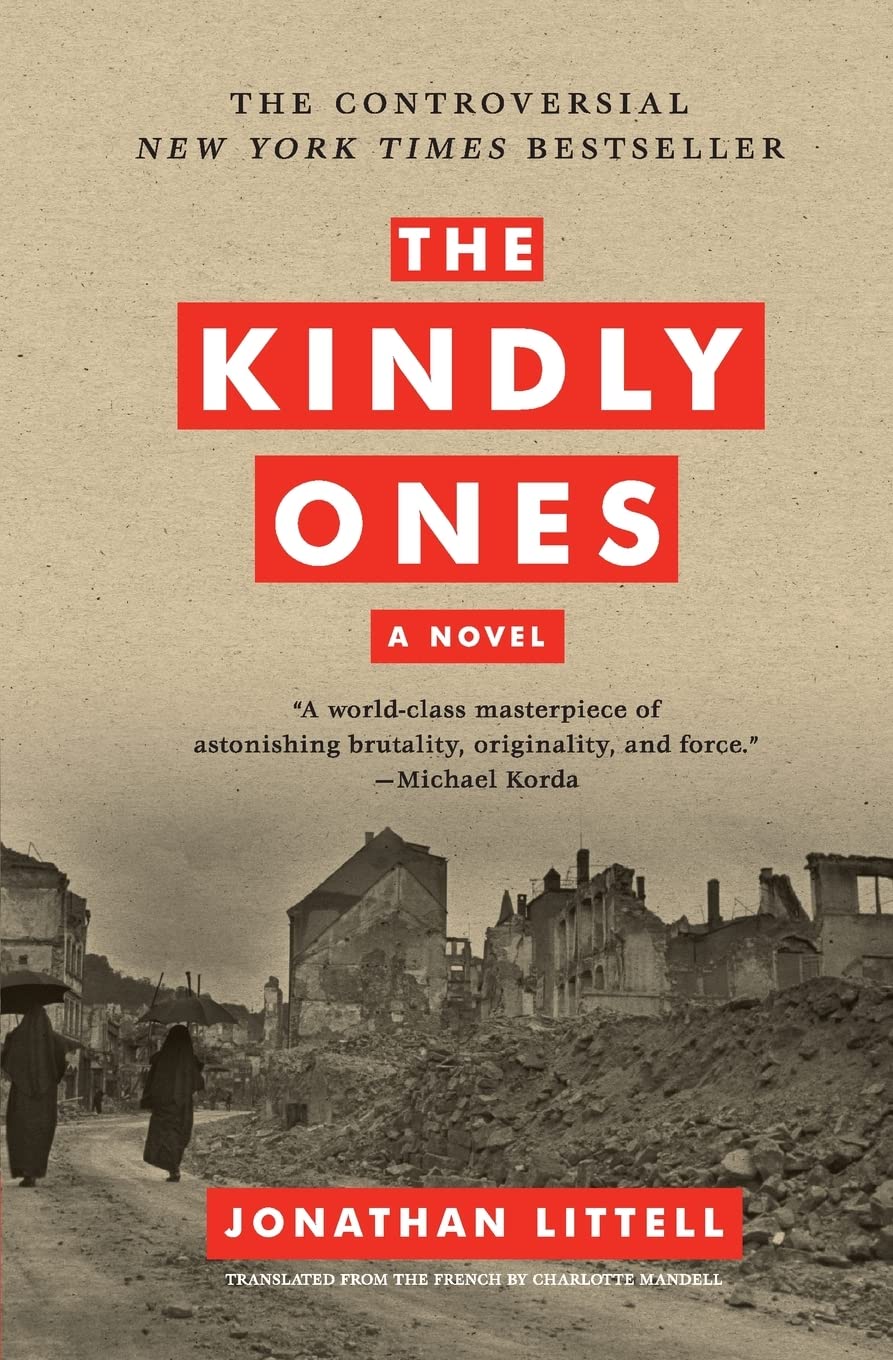
The Kindly Ones: A Novel
Set against the Second World War, the novel traces war crimes, personal responsibility, and memory through the recollections of former SS officer Maximilian Aue. Its relentless detail and cold perspective raise hard questions about morality and expiation.
Work Information
A sustained and unsettling portrait of war crimes and memory.
A French-language writer who won in 2006 for The Kindly Ones (Les Bienveillantes). The novel drew international attention for its large-scale treatment of war and perpetration.
Book Information
- Publisher
- Harper Perennial
- Published
- 2010-02-02
- Pages
- 992 pages
- Language
- 英語
- Size
- 4.04 x 13.49 x 20.32 cm
- ISBN-13
- 9780061353468
- ISBN-10
- 0061353469
- Price
- 4250 JPY
- Category
- 洋書/Literature & Fiction/Genre Fiction/Horror/Occult
“Simply astounding. . . . The Kindly Ones is unmistakably the work of a profoundly gifted writer.” — Time A literary prize-winner that has been an explosive bestseller all over the world, Jonathan Littell’s The Kindly Ones has been called “a brilliant Holocaust novel. . . a world-class masterpiece of astonishing brutality, originality, and force,” (Michael Korda, The Daily Beast ). Destined to join the pantheon of classic epics of war such as Tolstoy’s War and Peace and Vasily Grossman’s Life and Fate , The Kindly Ones offers a profound and gripping experience of the horrors of World War II and the Holocaust. A former Nazi officer, Dr. Maximilien Aue has reinvented himself, many years after the war, as a middle-class family man and factory owner in France. An intellectual steeped in philosophy, literature, and classical music, he is also a cold-blooded assassin and the consummate bureaucrat. Through the eyes of this cultivated yet monstrous man we experience in disturbingly precise detail the horrors of the Second World War and the Nazi genocide of the Jews. Eichmann, Himmler, Göring, Speer, Heydrich, Höss—even Hitler himself—play a role in Max's story. An intense and hallucinatory historical epic, The Kindly Ones is also a morally challenging read. It holds a mirror up to humanity—and the reader cannot look away.
Jonathan Littell was born in New York to American parents, and grew up in the United States and France. He lives in Barcelona, Spain.
Reviews
-
An excellent book that could have been a masterpiece.
I just loved to read this 1000 page book in English, though I see it now as a mistake not having read it in German for obvious reasons. It is very intense and quite rough at some points, opening now and then to interesting considerations concerning the war, the "Endlösung", the NSDAP, and so on. It is undisputable that the author made a serious and very detailed research for writing this book, even if we do not always agree with him. But agreeing or not agreeing is not the point. The point is to let us be dragged for a few days throughout a world of extreme violence ruled by perfectly normal people, which adds even more brutality to the whole affair. Those who think this is a kind of "American Psycho" placed at World War II will be deceived. What we deal here with is an extraordinary and historically accurate fall into the German war campaign, seen through the complex and sometimes disturbed mind of SS officer Maximilien Aue. And believe me, he does his job so well that you really feel to be part of all that madness. The flow of the story is very catching and we will stumble against some delicious characters with strong and interesting personalities along the way. Some critics accused Jonathan Littell, the author, of plaguing the pages with unacceptable scenes of pornography. Well, this is not true at all. There is in fact at the beginning a short detailed description of homosexual sex and at the end of the book some good five or six pages describing a dreamlike sexual state of feverish euphoria by Max Aue, which I believe was aiming at a better comprehension of his fragile state of mind at that particular moment. Among the 1000 pages and between these two scenes you will find perhaps four more sexual mentions with short "pornographically" content, though nothing which could be called disturbing. To brand this book as dirty because of this is simply pathetic to say the least. To be honest, some degree of pornography in a book that deals with much of the horrors of war could even be desirable. Nevertheless, I believe that in this field the author was not up to the task. Much of those scenes and some rough language could have been left out, not because of the "moral question" but because they just do not fit in. Every time Littell wrote the word shit, there seemed to be some uneasiness in the air, like if the context and phrasing would revolt. It simply did not sound good and almost always felt forced and unnecessary. This kind of matters should be left for masters like Bukowski, where every dirty word has a golden taste. All in all a fantastic book that misses the status of masterwork by a few inches.
-
Gotterdammerung
To begin, let me simply congratulate all who have accomplished the feat of reading this novel, whatever your views on it. For it is truly otherworldly in its ensorcelling vision, and, like some bewitching, daemonic potion brewed and spewed from the bowels of the Earth, incites real nightmares, cold sweats and waking spells of horror. Just casually glance over these reviews and note how many of the brave readers admit to having nightmares from the reading of it. And yet, it is magnificent, scholarly, erudite, mesmerising, and therein lies our problem and wonder. Let's start with the title: The Kindly Ones or the Eumenides from Greek myth. In Aeschylus' trilogy of plays, Orestia, it is the euphemism bestowed upon the Erinys, or Furies at the end of the plays in the hopes of appeasing these supernatural beings. They are given a home beneath the Acropolis by Athena and promised that they will be honoured by the Athenians with this new appellation and no longer treated with fear and loathing. One wonders just how long such supernatural beings will be appeased by these blandishments, and both men and the society that they have created threatened again by what is buried underneath. The entire novel deals with the terrors of what happens when they are released from their gemutlich abode and return to their true form, and it is unrelenting. It is a credit to Jonathan Littell's wizardly prose and his success in creating such a compromised narrator, Maximillian Aue, that from first to last page we scarcely think of our author, 21st Century Franco-American Jewish author Littell at all, so pulled in are we by Aue and the talons of the Furies - so Dante depicts them anyway. The novel, as many readers have noted, raises more questions than it answers; and it is so exhausting and exhaustive that a reviewer such as myself can only cover what I see as the two most piquant themes here: The first is the supposed "inhumanity" of the educated, cultured Nazis such as Aue who turn into killers, mass murderers, torturers, and, as one reviewer here has it, in the case of Aue, psychopathic sexual monsters, all described in the gripping detail of twisted pink intestines in the snow, the smashed crania of children and merde, merde and more merde. The sight of it, the smell of it and, yes, even the taste of it are so richly depicted that it becomes a psychosexual motif in the book for all we'd rather not know about ourselves. About all this, our narrator has several pointed passages: "There was a lot of talk, after the war, in trying to explain what had happened, about inhumanity. But I am sorry, there is no such thing as inhumanity. There is only humanity and more humanity." And, in the first chapter, so much resembling Baudelaire in Le Fleurs Du Mal: "But the ordinary men that make up the State - especially in unstable times - now there's the real danger. The real danger for mankind is me, is you." There are many other passages of this sort. But let me move on to the second more important, more encompassing point raised by this work by taking a cue from this last quote: What exactly is an "ordinary man"? A great part of the book is taken up by Aue's surreal, hallucinogenic, poetic passages describing his incestuous love for his twin sister Una. The themes in these passages of the book, of which Aue's homosexuality always seemed to me to be a symptom, make up the heart of the work and, indeed, as several astute reviewers have pointed out here, prevents it from being a meticulously researched "bombs and bunkers" book. A few professional reviewers have mentioned that this obsession seems to be "metaphysical" without explicating what they mean exactly. Aue explicates very well a philosophy with which every close reader of Plato, Plotinus, Shelley and Yeats will be very familiar. Here are some of the more pointed passages: "It wasn't just the question of my sister; it was vaster than that, it was the entire course of events, the wretchedness of the body and of desire, the decisions you make and on which you can't go back, the very meaning you choose to give this thing that's called, perhaps wrongly, your life." At the sight of dying, wounded soldiers crying for their mothers on the battlefield, Aue reflects: "Still, somehow I wondered if behind that mother there was not another one, the mother of the child I had been before something was irredeemably broken. I too would probably writhe and cry out for that mother. And if not for her, it would be for her womb, the one from before the light, the diseased, sordid sick light of day." Compare this to a stanza from the fourth of Yeats "Crazy Jane" poems: "A lonely ghost the ghost is That to God shall come; I -- love's skein upon the ground, My body in the tomb -- Shall leap into the light lost In my mother's womb." Briefly, and I don't have space to go into all this in an already overly long review, this is the "fall from the light" that each human's soul experiences upon birth in Neo-Platonic philosophy from what Shelley calls our "antenatal paradise." For the school's greatest philosopher, Plotinus, the object in life is a return to that "other light." But Aue is more pessimistic. Perhaps there is no return. One is reminded again of Yeats, from his poetic translation of another Greek play, "Oedipus At Colonus": "Never to have lived is best, ancient writers say; Never to have drawn the breath of life, never to have looked into the eye of day; The second best's a gay goodnight and quickly turn away." Or, as it may chance, slowly close this monstrous, bewildering book which fully lives up to the claims for it as art, art as a criticism of life.
-
beautifully written, and deeply troubling novel about the most ...
A richly researched, beautifully written, and deeply troubling novel about the most tragic historical event of the modern age - the Holocaust. It is about many other things too - family relations, sexuality, ideology, the individual and the state, friendship and mortality. It is also about sin and guilt. The novel is peopled by the willing executioners, from across the social spectrum, who brought the Holocaust into being, manifested primarily by Dr Aue, the conflicted and repellent narrator of this immense chronology. It's a long read, for sure, but the novel does bring something new and important to the literary canon of the Holocaust. In that sense, for the reader, it is a life-changing work, if not life affirming.
-
great book
Just over halfway thru this book ie >500 pages. Disagree with many reviews . Really finding it interesting although formatting and chapters unusual. A few bits I have skipped thru where author gets in bit too much detail or theory but not too much. Good to get a different view point on these issues. Side story is to say the least unusual. Pity the author as not written other novels as I would definitely read. Recommend anyone interested in Eastern Europe theatre WW2 and Stalingrad
-
Turbador y denso
En general, me parece una buena lectura, la cual se ve perjudicada por ese formato sin apenas puntos y aparte (cuando los piden a gritos) y la abundancia de términos alemanes para designar las distintas jerarquías militares y organismos o sociedades. Viene un glosario al final, pero aún así habría agradecido que los hubieran traducido. El trabajo de documentación que ha tenido que hacer el autor me parece ingente, y aunque hay páginas y páginas de disertaciones que, por lo que veo, a muchos han echado para atrás, a mí me han resultado didácticas (admitiré que algo pedantes también).