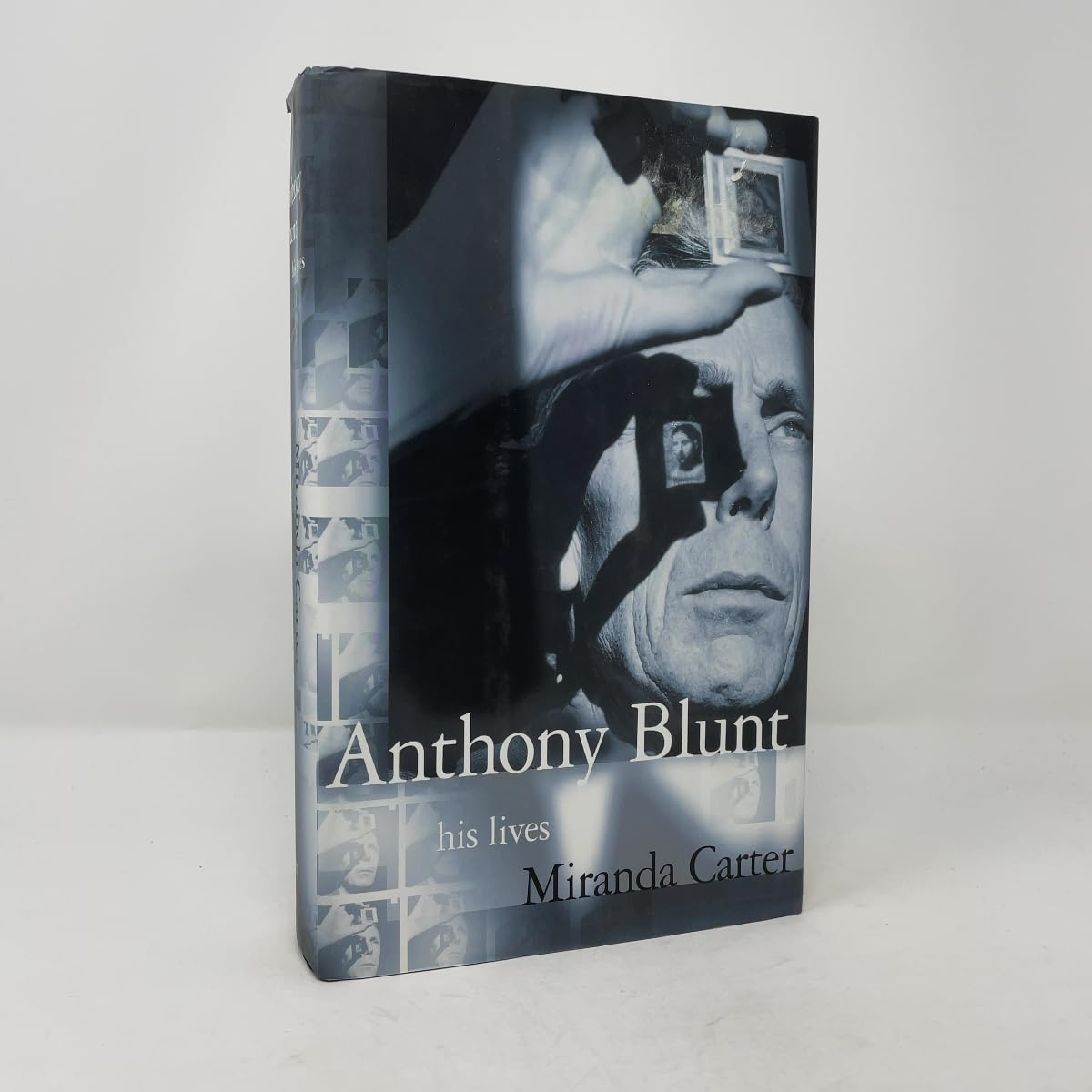
Anthony Blunt: His Lives
A biography of Anthony Blunt, who was both an art historian and a Soviet spy. By setting scholarly life against espionage, it reveals the intersection of power and culture in twentieth-century Britain.
Work Information
It untangles a double life while sketching the depth of Britain's intellectual world.
Miranda Carter portrays Anthony Blunt not only as an art historian but as a complex figure who embodied Cold War Britain. She turns a world where art, universities, the court, and intelligence services overlap into an intellectually rich biography.
Book Information
- Publisher
- Farrar Straus & Giroux
- Published
- 2002-01-15
- Pages
- 590 pages
- Language
- 英語
- Size
- 16.51 x 5.08 x 25.4 cm
- ISBN-13
- 9780374105310
- ISBN-10
- 0374105316
- Price
- 2599 JPY
- Category
- 洋書/Biographies & Memoirs/Historical
The first full biography of the notorious spy and an X-ray of the British ruling class that produced him. Once an untouchable member of England's establishmenta world-famous art historian and a man knighted by the Queen of Englandin a single stroke Anthony Blunt became an object of universal hatred when, in 1979, Margaret Thatcher exposed him as a Soviet spy. In Anthony Blunt: His Lives , Miranda Carter shows how one man lived out opposing trends of his centuryfirst as a rebel against his class, then as its epitomeand yet embodied a deeper paradox. In the 1920s, Blunt was a member of the Bloomsbury circle; in the 1930s he was a left-wing intellectual; in the 50s and 60s he became a camouflaged member of the Establishment. Until his treachery was made public, Blunt was a world-famous art historian, recognized for his ground-breaking work on Poussin, Italian art, and old master drawings; at the Courtauld Institute he trained a whole generation of academics and curators. And yet even as he ascended from rebellion into outward conformity, he was a homosexual when homosexuality was a crime, and a traitor when the penalty was death. How could one man contain so many contradictions? The layers of secrecy upon which Blunt's life depended are here stripped away for the first time, using testimony from those who knew Blunt well but have until now kept silent and documents from sealed Russian archives, including a secret autobiography Blunt wrote for his controllers. Miranda Carter's Anthony Blunt is the first full biography of the mythical Cold War warrior, and is at once an astonishing history of one the century's greatest deceits and a deeply nuanced account of fifty years in the British power elite, as experienced by one deep inside who wished to bring it down.
Miranda Carter was educated at St Paul's Girls' School and Exeter College, Oxford. She worked as a publisher and journalist before beginning research on her biography of Anthony Blunt in 1994. She lives in London with her husband and son. This is her first book.
Reviews
-
あまり新味はなかった
アンソニー・ブラントについては、今はもう絶版になっている、80年代後半にでたCONSPIRACY OF SILENCEに続く本です。 過去15年の英国並びに世界における変化を受け止めて(性に関する社会の許容度の変化、社会主義の破綻)、もう一度彼の謎に満ちた生涯をその全側面においてたどってみようという本です。特にこの本では、彼のCOURTAULD館長としてのART HISTORIANとしての部分にかなりの分量が割かれています。一読した感想としては、あまり新味は感じられませんでした。最近この種の本から遠ざかっていたためでしょうか、どちらかというと、彼の戦中のMI5時代のソ連のエージェントとしての部分を興味深く読みました。ただこの部分は、NIGEL WESTの最近の著作に依拠する部分が多く、必ずしも、この著者の本でなければ得られない部分ではないと思われます。ただ副次的ながらも、再確認させられた部分としては、やはり国を逃れた中欧の知識人が戦前の英国の美術批評並びに美術史研究に与えた影響の大きさですね。戦前のブラントに影響与えた人物として、ハンガリー出身のANTALらの名前が出てきます。またブラントのコントローラーとして出てくるDEUTSCHもウイーン大学で博士号をとった人物なんだよね。
-
this is a terrific book which I am reading in preparation for a Road Scholar tour, The Spying Game. Well beyond the topical interest of the fve Cambridge spies, Carter rebuilds the entire pre to postwar world that I grew up with, never quite able to understand how the Anglo European world was coming apart. The treatment is heavily British, as one would expect, and the clubby familiarity of the text can be wearying when it centers on Cambridge and Trinity Hall in particular. But it is nothing if not a denser portrait of the world Waugh made come alive and with which millions of Americans are familiar through the PBS Brideshead Revisited. Carter's work, through its broader almost exhaustive sweep makes it all far more grim, tawdry, frantic. It feels very uncomfortable to an American born in 1936, so far removed, isolated, from the desperation of Europe in the 30's, bankrupt and prostrate in the 40's and 50's. It is a sad story from beginning to end.
-
Good resd
-
A good read but the academic art criticism is learned but hard going for the uninitiated. This book is a tour de force of writing and research. A very balanced report.
-
Anyone who has studied Western Art History of the west will find this book informative and illuminating.
-
Good
Related Literary Awards
- Orwell Prize Edition 9 (2002) ・Winner