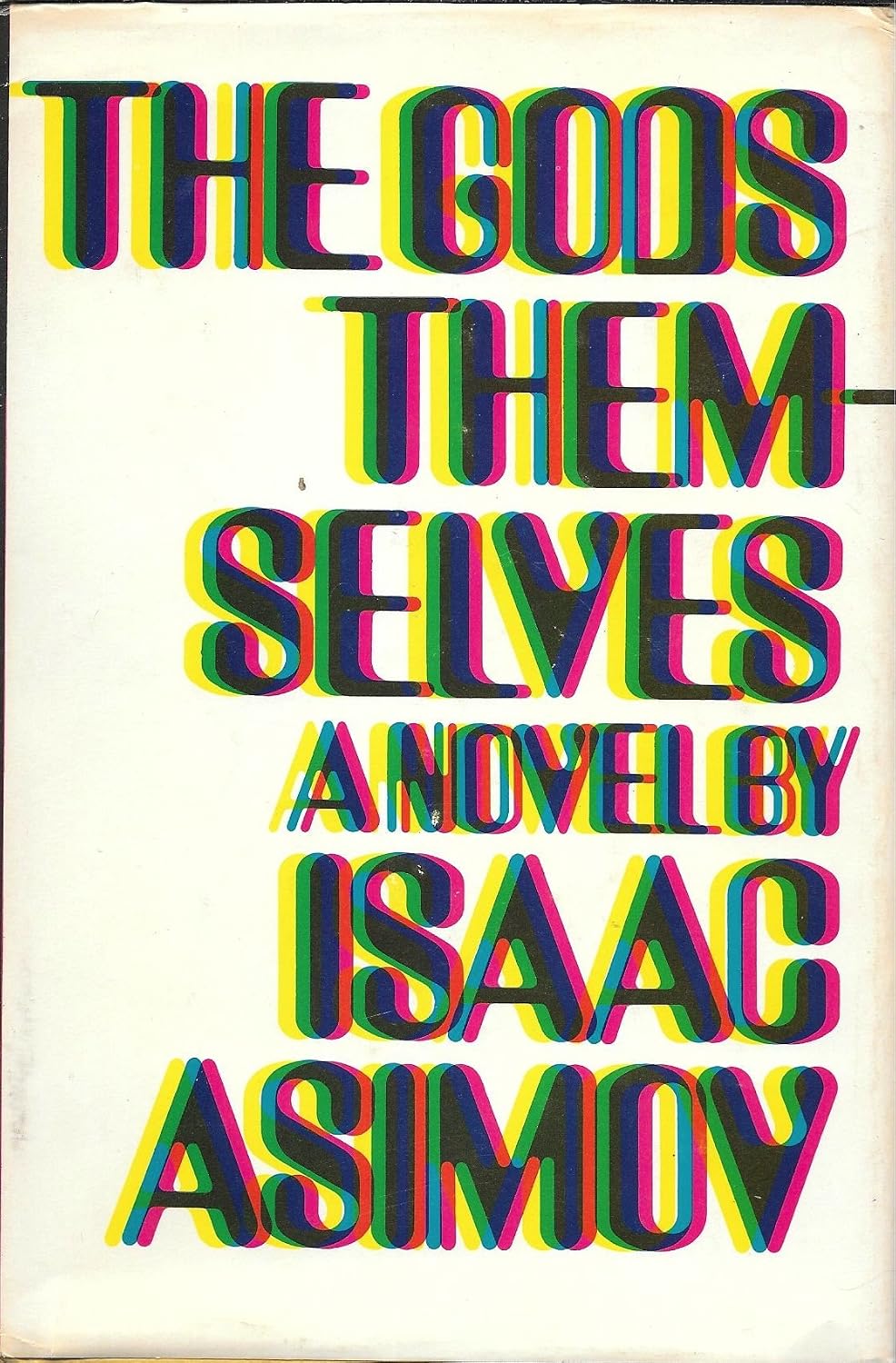
The Gods Themselves.
A three-part novel in which energy exchange with a parallel universe governed by different physical laws brings humanity prosperity while also creating a major crisis. It is a rational, science-driven meditation on ethics and the survival of civilization.
Work Information
Contact with a parallel universe brings humanity both prosperity and danger.
Winner of the 1973 Hugo Award for Best Novel, this Isaac Asimov novel examines the consequences of an energy exchange with a parallel universe. Japanese and English editions are both available.
Book Information
- Publisher
- Doubleday
- Published
- 1972-05-01
- Language
- 英語
- ISBN-13
- 9780385027014
- ISBN-10
- 038502701X
- Price
- 42426 JPY
- Category
- 洋書/Science Fiction & Fantasy/Science Fiction/Space Opera
The inhabitants from the earth, the moon, and another planet are drawn together by their concern about unrestrained material progress
Reviews
-
今でも読み応えは十分な古典的名作
青春時代に読んだ本書を今度は原書で読み直してみたが、今読んでもやはり面白かった。平行宇宙を描いた古典的な名作だと思う。 本書は3部に分かれているが、導入部の1部では平行世界から無尽蔵のエネルギーを供給を受けることを可能としたElectron Pumpが、実は太陽を爆発させる危険を秘めていることを発見した科学者がそれを証明しようと苦闘する様が描かれる。第2部ではうって変わって相手方の平行世界の住人達が主人公となるが、彼らの不思議な生態と最後のどんでん返しはさすがアシモフというしかない出来栄えだ。最後の第3部の舞台は一転して月が舞台となり、月で生まれ育った住民と地球政府との確執を背景に、主人公の科学者が解決方法を模索する姿が描かれるが、重力の軽い月での生活が非常にリアルで、とにかく面白い。 現代の重いSFと比べると実にコンパクトであるが、その中に様々なアイディアやあっと驚く展開がいくつも盛り込まれており、巨匠の筆のさえを堪能することができました。
-
Great stuff here
It is one of great Asimov novels. For some times it is quite slow, but in general is such a nice book.
-
You don't beat the refusal to believe by a frontal attack
One of the most important life lessons came to me through this book (although I still had to confirm it the hard way :-))
-
Una piacevole riscoperta
Avevo letto questo capolavoro di Asimov più di quarant'anni fa, e da allora la frase schilleriana che gli dà il titolo (Contro la stupidità, anche gli Dei colpiscono a vuoto) è entrata a far parte delle mie citazioni preferite. Sto rileggendo il libro in inglese con grande piacere (a parte la sensazione di ritornare alla mia giovinezza!....): il plot è originale, i personaggi sbalzati con vivacità, il racconto, nell'insieme, non ha perso smalto col passare degli anni, e il sottofondo ironico di Asimov aggiunge un tocco di distaccate leggerezza. Aggiungo infine, per i lettori italiani, che l'inglese di Asimov è assai trasparente, perciò la lettura risulta scorrevole anche per un lettore non di madrelingua.
-
A FANTASTIC, WORLDBUILDING THREE-PART SCI-FI STORY (PART 2 IS THE BEST!)
I chose this book as part of my ongoing goal to read every book that's ever won the Hugo Award for Best Novel: this is the 1973 winner, one of Asimov's five! I could tell right away that the book was worth my while, and it delivered right to the finish! BRIEF SYNOPSIS: The Gods Themselves tells the story of a not-to-distant future (though it was 100 years out for Asimov) in which a bumbling scientist (Frederick Hallam) stumbles upon a cross-universe transfer of energy that facilitates limitless clean energy for all mankind. The "science fiction" part of it is that the nuclear balances of protons and electrons are different between the two worlds, so when matter portals back and forth between the two universes its atoms produce continual energy as they work to adjust to the laws of their new universe. The problem, though, is a familiar one in science fiction: when man pushes against the laws of nature, nature pushes back. The story primarily follows two of Hallam's academic rivals who thwart his desperate bid to protect his scientific reputation by successfully alerting the world about the downsides of the "electron pump" and proposing a mind-bending alternative. FANTASTIC, VARIED SCI-FI: Comprised of three overarching parts (which, when strung together, form the quote by Friedrich Schiller: "Against stupidity the gods themselves contend in vain."), the novel really has about everything a sci-fi reader could want. Part 1 tells the story of Hallam and his great detractor, Peter Lamont. Lamont offers a great lens through which Asimov helps introduce readers to the world of the novel and provides ample opportunities for Asimov to decry the downsides of defensive, politicized science. Part 2 is my favorite: a detailed, emotionally-evocative glimpse into the "parauniverse" (parallel universe) that sends its matter to our own universe. The beings and family units in that universe form "triads" comprised of one emotional intelligence, one rational intelligence, and one parental intelligence. I don't want to give away too many spoilers here, but I will share that Asimov's creation of a completely different universe with fundamentally different laws of biology and physics is SUPER compelling. Taken alone, it's an absolutely first-class alien and worldbuilding short story of which I loved every second. I can't recommend Part 2 enough. (Note: In his autobiography, Asimov wrote that the novel, especially the second section, was the "biggest and most effective over-my-head writing [that I] ever produced".) Part 3 returns to our own universe and, to complete the sci-fi trifecta, is set on a human colony on the moon! Reminiscent of "The Moon is a Harsh Mistress", the denizens of the moon have adopted a different familial and social order than that found back on earth, setting up quite an interesting set of political and scientific clashes that lead to the climax of the entire book. CONFUSED PHILOSOPHICAL "BOTTOM LINES": As stated above, I sincerely enjoyed this novel and would recommend it to any sci-fi fan! But something didn't sit right with me at the end of it, and I couldn't figure out until the next day what it was--I didn't really like that, at the end of the day, the human race didn't face any consequences associated with the "stupidity" (Schiller/Asimov's word) that they exhibited by failing to take the threat of cross-universe tampering seriously. It was like reading a novel about climate change where, at the end of the day, nobody does anything differently but all the denialists get the self-satisfaction of being proven right in their do-nothingism after all. That rubs me the wrong way. I understand that Asimov wasn't really attacking that particular element of humanity (he instead focuses pretty extensively on the egoism of the scientific establishment), but it still got to me. My disagreement with the final resolution notwithstanding, this is an absolutely first-class sci-book and I enjoyed it fully! I will read it again, and put it on my short-list of classic sci-fi books to recommend.
-
Loved the imagination
Not a usual Asimov. Loved the imagination. This is one work I found to be at par with Cixin Liu's trilogy.
-
Brilliant Book
I read this book years ago and.was so pleased to find it. I totally enjoyed it. Excellent book. I recommend this book to anyone that loves science fiction.
Related Literary Awards
- Hugo Award Edition 20 (1973) ・Winner