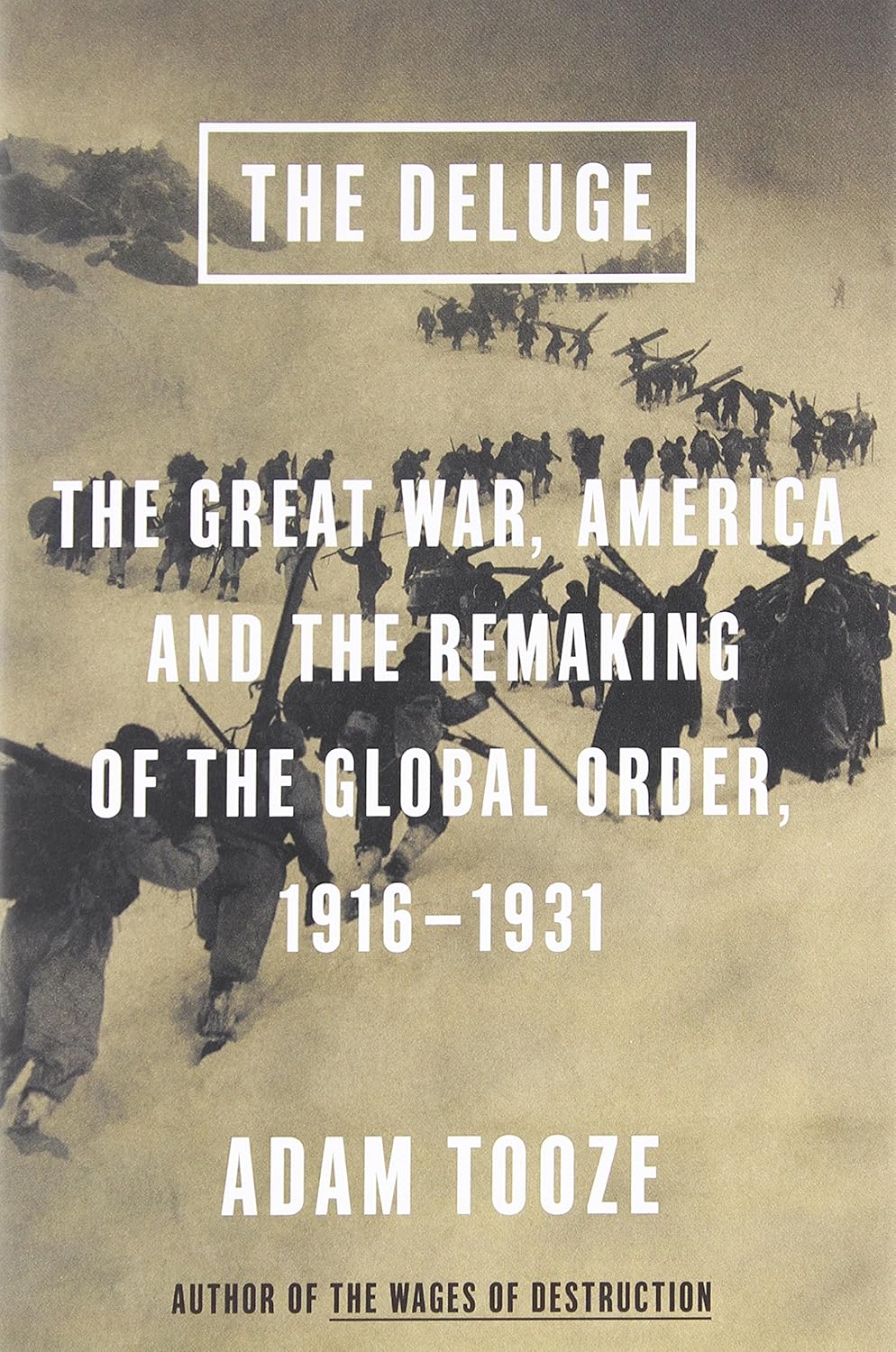
The Deluge: The Great War, America and the Remaking of the Global Order, 1916-1931
A history of how the United States and the global order were remade after World War I.
Work Information
The book takes a wide-angle view of political and economic change from 1916 to 1931.
Book Information
- Publisher
- Viking
- Published
- 2014-11-13
- Pages
- 672 pages
- Language
- 英語
- Size
- 16 x 5.18 x 23.52 cm
- ISBN-13
- 9780670024926
- ISBN-10
- 0670024929
- Category
- 洋書/History/Americas/United States/20th Century
Winner of the Los Angeles Times Book Prize - History Finalist for the Kirkus Prize - Nonfiction A searing and highly original analysis of the First World War and its anguished aftermath In the depths of the Great War, with millions dead and no imaginable end to the conflict, societies around the world began to buckle. The heart of the financial system shifted from London to New York. The infinite demands for men and matériel reached into countries far from the front. The strain of the war ravaged all economic and political assumptions, bringing unheard-of changes in the social and industrialorder. A century after the outbreak of fighting, Adam Tooze revisits this seismic moment in history, challenging the existing narrative of the war, its peace, and its aftereffects. From the day the United States enters the war in 1917 to the precipice of global financial ruin, Tooze delineates the world remade by American economic and military power. Tracing the ways in which countries came to terms with America’s centrality—including the slide into fascism— The Deluge is a chilling work of great originality that will fundamentally change how we view the legacy of World War I.
Adam Tooze is the author of Wages of Destruction , winner of the Wolfson Prize and Longman History Today Prize. He is the Kathyrn and Shelby Cullom Davis Professor of History at Columbia University. He formerly taught at Yale University, where he was Director of International Security Studies, and at the University of Cambridge. He has worked in executive development with several major corporations and contributed to the National Intelligence Council. He has written and reviewed for Foreign Affairs , the Financial Times , the Guardian , the Sunday Telegraph , the Wall Street Journal , Die Zeit , Sueddeutsche Zeitung , Tageszeitung and Spiegel Magazine , New Left Review and the London Review of Books .
Reviews
-
失敗作かな。
著者は現在2008年の北大西洋金融危機を対象とした作品を準備中のようで、その流れから著者のアプローチ(政治と金融の交錯の時代的な特徴を歴史的なパースペクチブの下で捉える)に感銘を受け、現在入手可能の著者の作品をとりあえず読んでみました。作品は2014年の第一次大戦100年を当て込んで出版されたようです。著者は「international history」, つまりある特定の国を題材とするのではなく、ある時期を対象としていくつかの主要な国々の動きと相互作用を軸として、時代を描くというアプローチをとっており、この分野ではスタープレーヤーのようです。 さて中身はどうでしょう。私の期待が大きすぎたせいでしょうか、読後感は平凡なものでした。まず第一章で、本作品の従来の研究との相違点が提示されるのですが、この時点から著者が提示するこの相違が明確には読み取れないのです。次に著者の文体です。日本人にはなかなか使いこなせない二重否定や著者独特の比喩が縦横無尽に駆使されており、これが著者のスタイルとはいえ、なかなか意味がストレートにくみ取れないのです。結果として、どうも本書の鍵となるテーゼが読者に訴えてこないのです。そして、このinternational historyというアプローチがどうも曲者です。英国、米国、フランス、日本、中国、ドイツ、ソビエトさらにはインド、アイルランドの国内政治や経済の事情や変遷にも後知恵を排し、それぞれ丁寧ね読み込み(hindsight deceives as well as it clarifies!)が行われ、それなりのスペースが割かれるのですが、どうもそれぞれのおさまりと総合(synthesis)の印象が弱いようです。たしかに目配りの射程は広がるのですが、ローカルな明暗そして裏表がどの程度適切に選択され提示されているかについての疑問が残ってしまいます。 いろいろ難点だけを挙げてしまいましたが、ドイツの賠償負担と連合国の間での負債(inter-allied debts)の関わりの部分は本書の中で特に参考になる部分です。第一次大戦後に出現したアメリカを究極の債権者とするこの負債の構造は、専門的な領域であり、どうも従来の類書の中では無視はされないまでも副次的に扱われてきたテーマです。著者は、この構造を丁寧に分析し、この処理が大戦後の国際関係のdefining featureであったことを明らかにしていきます。 全体としては、野心的なテーマにもかかわらず、このテーマにふさわしい結論をわかりやすく提示することには成功していないようです。単線的な構図の歴史ではなく、アメリカの登場という構造的な拘束の下で様々な可能性が交錯した時点の営為の集積として歴史を描くという著者の狙いは妥当なものですが、つまるところあまり面白くない作品になってしまったようです。
-
I had not a lot of doubts about Tooze but this is really a masterpiece. Even more insightful than the wage of destruction
-
Adam Tooze är en kunnig ekonom med goda kunskaper. om nazityskland ekonomi. Kan gott rekommendera böcker av Tooze. Genomgången av kraschen 2008 kunde väl vara en beskrivning av. dagens ekonomiska situation i världen. I den nu aktuella boken ( The Beluge) ger det tråkiga pappret en lite tråkig läskänsla.
-
Very interesting and incisive
-
Explains all the factors that led inexorably to another war. Woodrow Wilson has a lot to answer for. His vision was of a world controlled by US financial muscle. He deplored imperialism - particularly British imperialism - and armed force; but the world was not ready for a toothless League of Nations or a Peace Without Victory. The Versailles deliberations were bedeviled by Wilson's ideals; no wonder Germans looked to him to rescue the Weimar Republic from the consequences of the war the Kaiser had brought about. Alas, Wilson's ideals were rejected by an isolationist Congress, and he died a disappointed man. Wall Street's more practical outlook prevailed: no finance without stable government. Japan, disgruntled at being sidelined by the West, embarked on the conquest of a chaotic China; Italy under Mussolini embarked on the conquest of various Mediterranean countries that were too ill-equipped to resist him; and Germany's democracy was torpedoed by a financial hangover from the War. All over the world during the 1920's, governments seesawed between right and left. The toothless League of Nations, although it did some good work, proved inadequate when faced with the real challenges of the inter-war period. The Wall Street crash of 1929 showed that America was not, after all, to be relied on. (Indeed, 2008 proved that Wall Street is still not to be relied on. And present -2025 - American policies underline the dismal fact that America can never be relied on.)
-
Excelente estudio sobre las dificultades para la edificación del nuevo orden mundial surgido tras la Gran Guerra. Recomiendo fervorosamente su lectura.