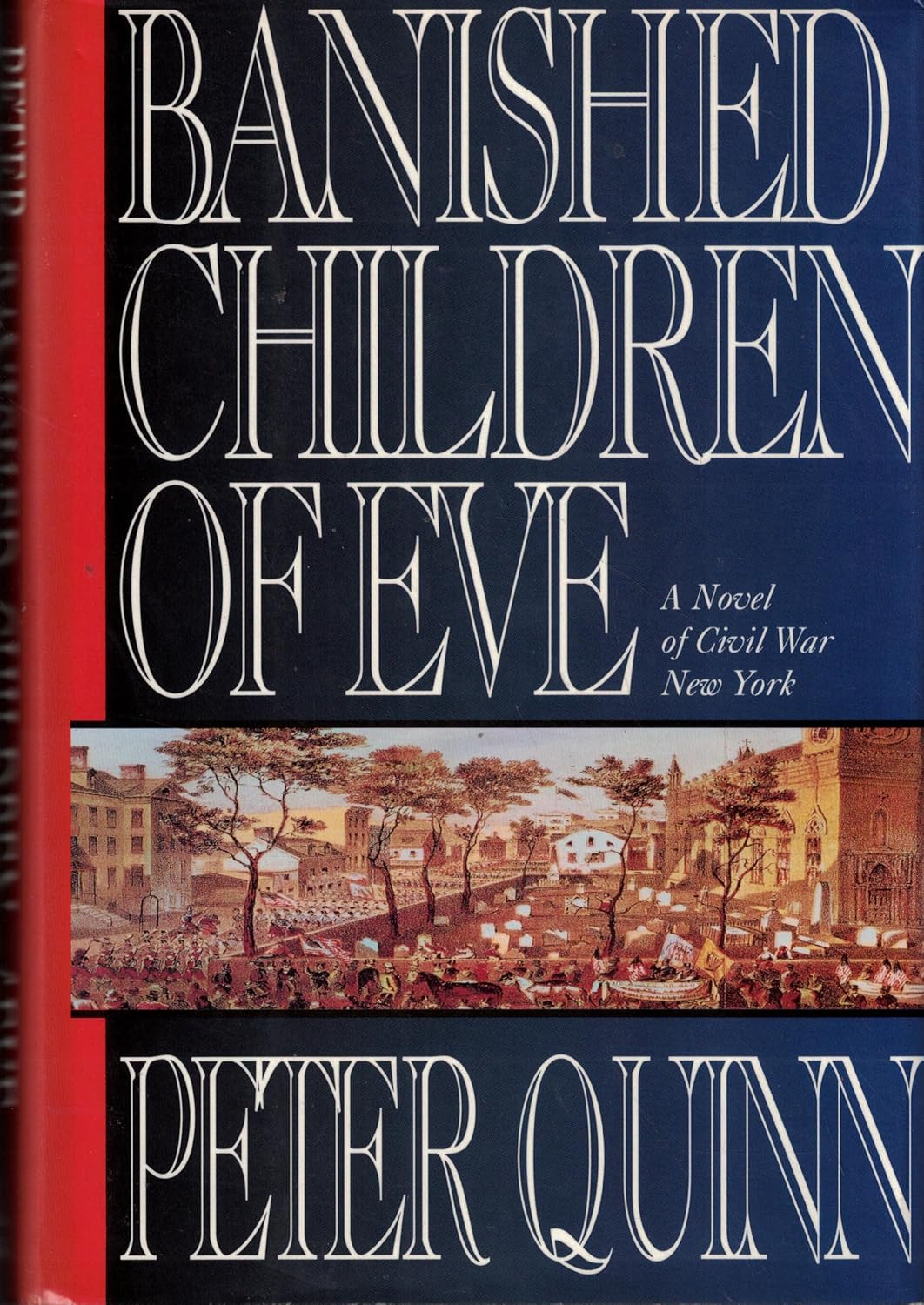
Banished Children of Eve: A Novel of Civil War New York
In post-Civil War New York, the lives of immigrants, wanderers, and people on the city’s margins intertwine. The result is a layered historical novel where revenge story and civic history overlap.
Work Information
In the postwar city, stories of the dispossessed cross paths.
A sweeping historical novel set in post-Civil War New York, tracing revenge, survival, and the immigrant experience.
Book Information
- Publisher
- Viking Adult
- Published
- 1994-03-17
- Pages
- 624 pages
- Language
- 英語
- Size
- 50.8 x 50.8 x 50.8 cm
- ISBN-13
- 9780670850761
- ISBN-10
- 0670850764
- Price
- 11296 JPY
- Category
- 洋書/Literature & Fiction/Contemporary
A likable Irish-American hustler, a Yankee stockbroker, a beautiful mulatto musical comedy star, and her white minstrel lover experience life in New York City during the Civil War Draft Riots. TV tie-in. 50,000 first printing.
Reviews
-
Excellent
Excellent
-
Historical Fiction as It Should Be
Peter Quinn's "Banished Children of Eve, A Novel of Civil War New York" is everything that historical fiction should be. It is an engaging story laced with characters drawn from history, intertwined with the author's own characters. The result is a novel on an epic scale which captures the gritty flavor of Civil War era Manhattan. Readers of Doctorow's "Ragtime" or Baker's "Paradise Alley" or Delillo's "Underworld" will find themselves in familiar terrain here. Those not familiar with this type of prose may be put off by the insertion of history into the narrative or may wonder at how exact this history is. There is no doubting the precision of any of Quinn's research. Reading this book hot on the heels of Barnet Schecter's "The Devil's Own Work", I can make that assertion with utmost confidence. But this, in no way, is meant to take away from the other element of the novel, and that is the sympathy we have for most of the characters. The financier, the archibishop and his assistant, the minstrel player, the maid, the barkeep, and the man who frames the book, James Dunne, breaking/entering and yegg specialist. In no other novel, in my opinion, is the plight of the famine Irish and the generation that followed more poignantly and dramatically portrayed. This book has been in print for over ten years. These are just some of the reasons for that. Rocco Dormarunno author of The Five Points, a Novel
-
"Inside" Story of America's Most Brutal Riots
This is a story of the New York City Draft Riots of 1863. In spare and effective prose, we are given the elements which caused the all-time greatest loss of life and property through civil disobedience ever seen in the U.S. It's an easy read in spite of the task at hand. Quinn is a master storyteller and he weaves sympathetic and easily understood characters through his plot. Among them are one of the nation's most revered songwriters, Steven Foster, and other persons of importance who make this story strong and relevant. A moving piece of history.
-
Not tightly plotted but a wonderfully researched, panoramic picture of the times
As the author of a historical novel that is also set during the Civil War, I was blown away by the magnificently researched depiction of the times in The Banished Children of Eve. It’s hard to believe that author Peter Quinn was not actually alive in 1863, and a witness to New York during the Civil War: to the newly built mansions and to the shanty towns, to the concert saloons and orphanages, to the theaters and the railway cars which were switched from steam engines to horsepower when entering downtown streets. He has written a novel grand in its scope, and one that left me with a significantly greater understanding of the economic unfairness that lay behind the New York City Draft Riots. I had actually included a scene in my own novel depicting the murderous attacks on black men, women and children – even on the Colored Orphan Asylum - by white mobs of predominantly Irish immigrants. But I hadn't truly understood the cruelty of the economic system that literally starved poor Irish families, thus pitting impoverished white immigrants against similarly impoverished blacks for jobs that paid a mere pittance. The poor were kept at each others' throats – and out of banding together in unions – while no one but the Robber Barons profited. The novel is richly populated with characters both poor and rich, from freed blacks to recent immigrants, and from various walks of society, both fictional characters and real historical ones, such as beloved composer Stephen Foster. But just as the reader is becoming invested in any particular character, the narrative shifts to a flashback of his or her father, mother or great grandparents or to another character altogether. This is not a book for readers who want a tightly plotted story, and it can make for some slow reading. But for those who want a panoramic picture of the times and the great city beset by riots over the passage of the Civil War draft law, it excels.
-
Great work a masterpiece in my mind.
I am not going into depth about the story because others have done so and not to my liking. This book is the best I have read in a long time. I could not put it down and got so involved in the history of it. I have purchased several copies and given them to my children and to friends I know appreciate a good read. I did not get one negative response from anyone I gave a copy to. They all felt the same as I. One copy even went to a friend that teaches at University locally. I have read Mr. Quinn's other books and found them to be good too. Now I am in wait of the newest book which I have pre-ordered and I am very anxious to read another masterpiece.