James Tait Black Memorial Prizes
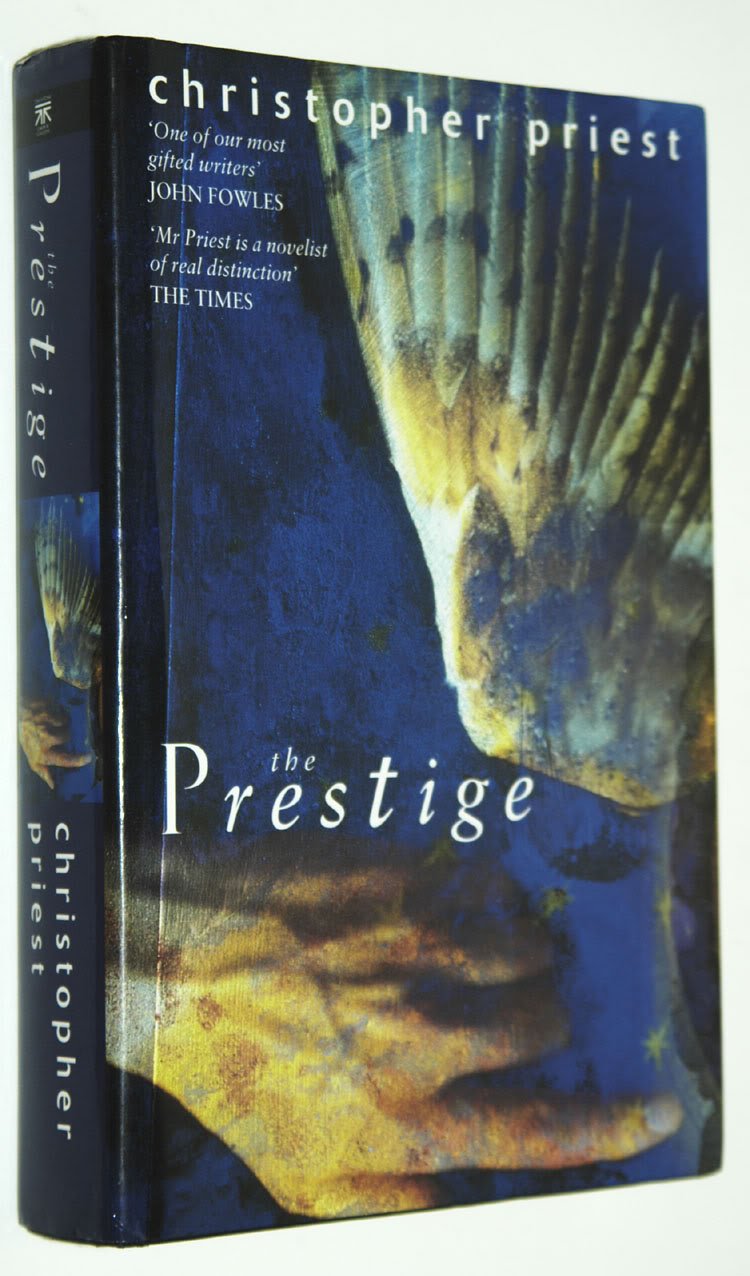
The Prestige
A novel about the rivalry between two stage magicians, told through a layered diary structure.
Work Information
The diaries accumulate until competition and secrecy begin to change shape.
Its stage-like structure gradually turns rivalry, deceit, and obsession inside out. It is the kind of novel whose mechanism stays with you after the last page.
Book Information
- Publisher
- Simon & Schuster Ltd
- Published
- 1995-09-04
- Pages
- 448 pages
- Language
- 英語
- ISBN-13
- 9780671719241
- ISBN-10
- 0671719246
- Category
- 洋書/Children's Books/Science Fiction & Fantasy/Fantasy & Magic
A story spanning three generations of people, bound not only by blood, but by the inheritance of a terrible and deadly secret. The novel explores magic, the phenomenon of twins, the veracity of science, parallel worlds and the very essence of reality itself.
Reviews
-
Finely crafted bit of work
The writing is excellent. The split structure works well as a narrative choice. Parts 1-3 as well as 5 whizzed by but part 4 was a bit of a slog. Angier’s is written as a verbose narrator I suppose. Picked this up because I enjoyed the movie and wanted to see how they compared. I found both a delight too read.
-
En illusionnisme, « le Prestige » est le point d’orgue d’un tour de magie, le moment où le prestidigitateur fait jaillir l’impossible du possible, suscitant ainsi stupeur et enchantement. Tout ceci n’est évidemment qu’illusion et si le spectateur s’y laisse prendre volontiers, les autres magiciens n’ont qu’une hâte : découvrir la clef de l’énigme. Car le Prestige n’est pas seulement source d’émerveillement, il l’est également de fortune, de gloire et de réussite. Un état de fait qui n’a jamais été aussi vrai que dans l’Angleterre victorienne où les théâtres à la mode se disputent les numéros de magie et où tous les praticiens de ce noble art se livrent à une lutte acharnée pour attirer l’admiration exclusive du public – une lutte qui peut aller fort loin car pour acquérir un nouveau tour ou le subtiliser à un confrère, des illusionnistes sont prêts à commettre bien des vilénies, allant jusqu’à l’espionnage, au vol et pire encore. Nous sommes à la fin du XXe siècle à Londres où un conflit de ce type va naître entre deux jeunes magiciens, tous deux aussi talentueux et orgueilleux l’un que l’autre, Alfred Borden et Rupert Angier. Un accident tragique et personnel va débuter leur querelle, querelle qui ne va pas tarder à dangereusement dégénérer, la haine entre les deux illusionnistes atteignant des sommets sans commune mesure avec l’élément déclencheur du duel. Surtout que l’enjeu du conflit n’est pas mince : rien de moins que le tour le plus demandé et le plus mystérieux de toute l’Angleterre, celui de « L’homme transporté » où l’illusionniste se transfert instantanément d’un coin à l’autre d’un théâtre. Des petites échauffourées, on passe progressivement à des actes de malveillance de plus en plus graves, menaces, vandalismes, chantages… Aucun acte, aucune extrémité ne semble à même de rebuter les deux hommes dans leur course forcenée à la gloire. Où s’arrêtera l’escalade ? Avec « Le Prestige », Christopher Priest nous offre une captivante plongée dans le monde de la prestidigitation avec ses secrets, ses traditions et ses multiples codes. Doté d’une ambiance très réussie, le roman est mené comme un tour d’illusionniste ; tout n’y est que faux-semblants, fausses pistes, semi-mensonges, au point qu’il y devient parfois difficile de distinguer la vérité de l’élucubration et l’illusion du fantastique… Le récit se démarque par une construction particulièrement ingénieuse : on y découvre d’abord les mémoires d’Alfred Borden, avant d’enchaîner sur le journal intime de Rupert Angier (ses deux récits étant entrecoupés de passages fort intrigants se situant au début du XXIe siècle et mettant en scène leurs descendants respectifs). Les récits des deux magiciens se complètent, se contredisent, s’éclairent et s’obscurcissent l’un l’autre, créant ainsi une suspense grandissante qui trouve sa conclusion dans un final de haute volée. Quand l’histoire prend fin et que le Prestige nous est enfin révélé, bien des zones d’ombre persistent… Mais où serait le plaisir d’un tour de magie, si tout nous était dévoilé ?
-
So far, this book is a great read. Can't put it down, except to write this review. Would recommend to anyone!
-
The Prestige is the ninth novel by the British SF author Christopher Priest. It was first published in 1995 and won the World Fantasy Award for that year. It is Priest's best-known novel and apparently his most successful. It is currently being made into a film by Christopher Nolan (Batman Begins, Memento) starring Hugh Jackman and Scarlett Johansson, due for release in late 2006/early 2007. The Prestige is the story of two feuding magicians from the late 19th Century, the aristocratic Rupert Angier and his working-class nemesis, Alfred Borden, and how that feud affects later generations of their families, personified in the mid-1990s by Borden's descendent Andrew Westley and Kate Angier. A strange mystery has haunted Andrew's life and his search for the answer leads him to Kate and the story of the feud. From there the novel takes us back some 130 years and relates, in two separate sections, the life stories of Alfred Borden and Rupert Angier. Borden's story is told as a somewhat (deliberately) confused narrative, supposedly a commentary on a book on stage magic, but Borden's need to tell his story takes over and he goes into detail about his life and the feud with Angier. We learn that Borden develops an incredible magic trick which no-one can fathom, a trick which is then improved upon by Angier, to Borden's fury. The narrative then switches to Angier's more formal diary. Angier's story forms the bulk of the novel and takes us through his youth and his slow beginnings at the art of magic until his fateful meeting with Borden and the consequences of that meeting. Priest tells his story by shifting between four first-person narratives (Andrew and Kate in the present, Rupert and Alfred in the past), altering his prose style between the two periods with apparent ease and painting these four central characters and the other characters described in their tales with depth and layers. As well as giving an insight into the world of stage magic he brings turn-of-the-century Britain to life with its slow, reluctant letting go of the old century and its embrace of the new, symbolised by the power of electricity. Electricity itself is nearly a character in the novel, the awe which Angier holds it in described with a nearly fetish-like quality and brought to life through the historical figure of Nikolai Tesla, who plays a minor but key role in the narrative. The Prestige is a puzzle built upon twists, turns and conflicting mysteries. It's like an M Night Shymalan film but one where the twist you were confidently expecting is suddenly yanked out of sight and something unforseen being dropped in its place. Some may question whether if this is really an SF novel, so subtle are the ideas being explored here, but by the end of the book more overt SF elements have emerged and it is a tribute to Priest's writing that he keeps things firmly grounded in reality. The ending, when it comes, may strike some as abrupt, but on another level it is the perfect, ambiguous ending to a nearly perfectly-tuned mystery. The Prestige is one of the most finely-written, 'different' SF novels I've ever read, and firmly recommended to all.
-
Just brilliant! But let me warn you, the movie is better than the book! But the book is still good, An absolute riveting read. We just dive head on to the world of magic of a forgotten era. If you enjoy a complex narrative then you'll enjoy this. There is the business of magic, well etched lead characters, Telsa, love, betrayal and much much more.
-
Kurz und knapp: Musste mir das Buch für die Uni anschaffen und habe es dann relativ zügig durchgelesen. Ich hatte Bedenken, weil ich den Film schon gesehen hatte und das Buch schon relativ umfangreich war. Doch da das Buch Aspekte und Handlungsstränge enthält, die nicht in den Film übernommen wurden, hat es richtig Spaß gemacht es zu lesen. Gerade beim Ende habe ich sehr mitgefiebert.