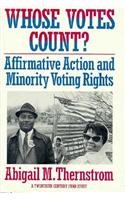
Whose Votes Count?: Affirmative Action and Minority Voting Rights (Twentieth Century Fund Study)
A scholarly study that examines how voting-rights law was transformed within race policy and electoral institutions. It critically follows how a system that expanded Black participation was later recast under a different political logic.
Work Information
Where did the system around voting rights change the meaning of fairness?
The book argues over how the 1965 Voting Rights Act expanded and changed from its original intent. Through debates over election systems, districting, and remedies, it asks what equality in voting really means.
Review Summaries
-
The book is valued for clearly organizing the evolution of voting-rights law and for presenting the tension between minority representation and local autonomy to a broad readership.
Book Information
- Publisher
- Harvard University Press
- Published
- 1987-09-10
- Pages
- 316 pages
- Language
- 英語
- Size
- 15.88 x 3.18 x 24.13 cm
- ISBN-13
- 9780674951952
- ISBN-10
- 0674951956
- Price
- 13863 JPY
- Category
- 洋書/Politics & Social Sciences/Politics & Government/Elections & Political Process/General
The Fifteenth Amendment to the Constitution of the United States guarantees that all citizens have the right to vote without regard to their "race, color, or previous condition of servitude." For almost a century the Fifteenth Amendment was a dead letter. Throughout the South millions of nonwhite Americans were excluded from the political process by poll taxes, literacy tests, and other devices. The landmark Voting Rights Act of 1965 sought to end that injustice. In this absorbing book, political scientist Abigail Thernstrom analyzes the radical transformation of the Voting Rights Act in the years since its passage. She shows how a measure carefully crafted to open the polling booths to southern blacks has evolved into a powerful tool for affirmative action in the electoral sphere--a means to promote black and Hispanic officeholding by creating "safe" seats for minority candidates, What began as an effort to give minorities a fair shake has become a means of ensuring a fair share. Thernstrom demonstrates how voting rights have created a "political thicket" in which Congress, the courts, and the justice Department have been lost. Why this should be true, how small statutory changes led to large and unexpected results, how civil rights groups prevailed against a conservative Senate, how Republicans have benefited from gerrymandering to increase black officeholding--these stories are all part of Thernstrom's well-told tale. Even though the concept of the right to vote retains an aura of moral simplicity, the issue of minority voting rights is perhaps the most complex, yet least studied, of all affirmative action issues. Whose Votes Count? should stimulate the overdue discussion that the subject deserves among all those concerned with American politics.
Abigail Thernstrom a senior fellow at the Manhattan Institute in New York, a member of the Massachusetts State Board of Education, and the vice-chair of the U.S. Commission on Civil Right