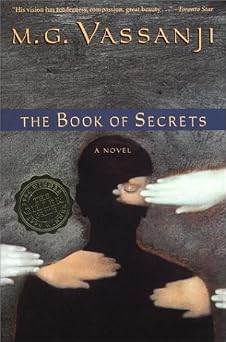
The Book of Secrets
When an old diary surfaces in Dar es Salaam, a retired schoolteacher begins tracing the memories and family history that lead back into colonial East Africa.
Work Information
A single diary reconnects a private life to colonial history.
Using a diary as its hinge, the novel layers colonial rule, migration, memory, and belonging. Its narrative digs into the past and turns that excavation into self-understanding.
Review Summaries
-
Readers often value the layered structure and the precise evocation of East African social history. Many are willing to meet its slow pace as part of the novel's depth.
Book Information
- Publisher
- McClelland & Stewart
- Published
- 1994-04-01
- Pages
- 352 pages
- Language
- 英語
- Size
- 15.24 x 3.18 x 22.86 cm
- ISBN-13
- 9780771087196
- ISBN-10
- 0771087195
- Price
- 6580 JPY
- Category
- 洋書/Literature & Fiction/Genre Fiction/Historical
The Book of Secrets is a spellbinding novel of generations and the sweep of history which begins in 1988 in Dar es Salaam when the 1913 diary of a British colonial officer is found in a shopkeeper’s back room. The diary enflames the curiosity of a retired schoolteacher, Pius Fernandes, whose obsession with the stories it contains gradually connects the past with the present. Inhabiting the story is a memorable cast of characters, part of an Asian community in East Africa, whose lives and fates we follow over the course of seven decades. Rich in detail and description, M. G. Vassanji’s award-winning novel magnificently conjures setting and the realm of eras past as it explores the state of living in exile from one’s home and from oneself.
M. G. Vassanji was born in Kenya and raised in Tanzania. Before coming to Canada in 1978, he attended M.I.T., and later was writer-in-residence at the University of Iowa in their prestigious International Writing Program. Vassanji’s fiction to date comprises five novels and a book of short stories: The Gunny Sack (1989), which won a Regional Commonwealth Writers Prize; No New Land (1991); Uhuru Street (short stories, 1992); The Book of Secrets (1994), a national bestseller and the winner of the inaugural Giller Prize; Amriika (1999); and, most recently, The In-Between World of Vikram Lall (2003), which won The Giller Prize. Vassanji was awarded the Harbourfront Festival Prize in 1994, in recognition of his achievement in and contribution to the world of letters, and was in that same year chosen as one of twelve Canadians on Maclean’s Honour Roll. M. G. Vassanji lives in Toronto.
Reviews
-
Slightly difficult written for a non native, but content wise great
-
One of my favourite Authors - highly recommend to read this book.
-
From the In Between World of Vikram Lall to this Book of Secrets, each story continues a mural of a world never known to me before... Vassanji will enrich your world
-
3.5/5 "...I was dumbfounded, and for the first time the thought came to me : What exactly had we achieved? Some satisfaction, yes, in having brought up a generation - but what comfort that, in lonely old age?" ~ The book of secrets, M.G. Vassanji Unsolved mystery. Lots of secrets. Complex plot. And numerous characters. These words are enough to describe this book. Before starting this book I had a preconceived notion that this might be a typical boring book. As it was nowhere in the gram, not much in Goodreads. Still I had to read so I began with a heavy heart and a cup of brewed coffee. And later I was totally stunned by this. Okay so cutting my crap short let's begin (why am I sounding like a youtuber) Duh "The Book of Secrets" by 'M.G. Vassanji' is a diaspora novel which gives us an insight of war time. The story begins in Dar - es - Salaam, 1988 ; when a diary of a British colonial officer was found written in 1913. The diary enflames the curiosity of the retired teacher Pius Fernandes, who later tries to connect the missing dots of this diary. This investigation unravels a story of forbidden liaison and shimmering vengeance, family secrets and later it lead him through his own past. The book is divided into three parts. The first part deals with the love triangle of Alfred Corbin (British colonial officer), Pipa and Mariamu; the second part describes the life of Ali, Mariamu's son and the third part brings the ultimate twist by describing about Gregory who was Pius Fernandes' companion. It would be difficult to mention the main character. Because there where so many characters and in each part the protagonist's were different. Not that each part has a whole different story. Each part is connected to one another. Infact I would rather say that Vassanji has very well woven the generation plot and has shown the visuals of that era through his work. Though I liked the book still there were few things which bothered me, the first one was there were lots of local terms that where used. Though at the end the book has the glossary about which I was clueless so this kept irritating me while reading the book. Secondly, the plot was good but it was bit confusing at the same time because along with the diary's description (which Pius had found) he kept on adding his own thoughts too. And the last thing was that till the end of the book new characters were introduced which froze my mind. So definitely this one is not for the beginners. But I would love to discuss this with anyone and everyone if you have read this.
-
Vassanji writes superbly, and does paint vivid pictures on his East African canvas, spanning the twentieth century. Through the stories he tells, the history of the region is glimpsed, in an interesting way. But this is a book also about books, stories and history themselves. Starting and ending with the "Book of Secrets" of the title, a diary kept by a British colonial administrator, the novel weaves its way through the personal and family histories of those linked to this book. There is a rich theme here of secrecy and disclosure, partial knowledge and understanding; some secrets are disclosed, others not. This ties in neatly with themes of literacy and education. The whole novel is an exploration of how full or partial our understanding of history - even our histories - ever is; some of this is discussed more explicitly towards the end of the book. How well does the exploration of this theme work? I'm not sure, actually. The issue of partial perspective (in both senses of the term - partial = not full, and partial = because of party interest) is raised, and handled in terms of what is lost and unrecorded, and the reliability of what is recorded. However, in the novel what is disclosed or not is actually very much the choice of the narrator, and fianlly for moral/comapssionate reasons, not because it is unknown. The diary does not remain secret or lost, and some sections of it are 'transcribed' - though not those which we and some characters in the novel would most like to read. So the novel becomes a partial history mostly by the choice of the narrator, less because of the partial perspective and knowledge of those looking back through history, or the reliability or otherwise of the remaining record; it is largely the choice of the present narrator not to make some secrets known that keeps history so patchy. Perhaps this was exactly what the author wanted to explore, but it seemed to me that a larger theme of interest, perspective and knowledge was raised, while what actually happened was down to present authorial choice (both in the novel as Vassanji writes it, and in the disclosure / secrecy chocen by his narrator, Fernandes). Here, the author (both Vassanji and Fernandes) is not the disinterested, impartial, objective third-person narrator of the traditional novel, true. However, these authors tell us much less than they know, so it is the reader even more than the author who becomes the victim of partial story-telling. As I say, perhaps this is exactly what Vassanji wanted to explore, but I was not sure it worked as well as I hoped, as the novel progressed. (So it seemed a little too easy to say, "Look, history is partial because we choose not to tell all, just like me, here, writing this story.") I have wavered, then, between a 3 or 4 star rating for this book. 4 for the rich, vivid, evocative writing; perhaps 3 because the ending does not bring any real sense of satisfaction (though this is perhaps the point, partly, of course), and for the thematic exploration ... and yet, in making the reader ask about the reasons for the partiality of our histories, Vassanji has surely achieved his purpose at least in part. So he's surely earned his 4 overall! I do recommend the book, with the caveats I've tried to explore here. Rick Simpson
Related Literary Awards
- Giller Prize Edition 1 (1994) ・Winner