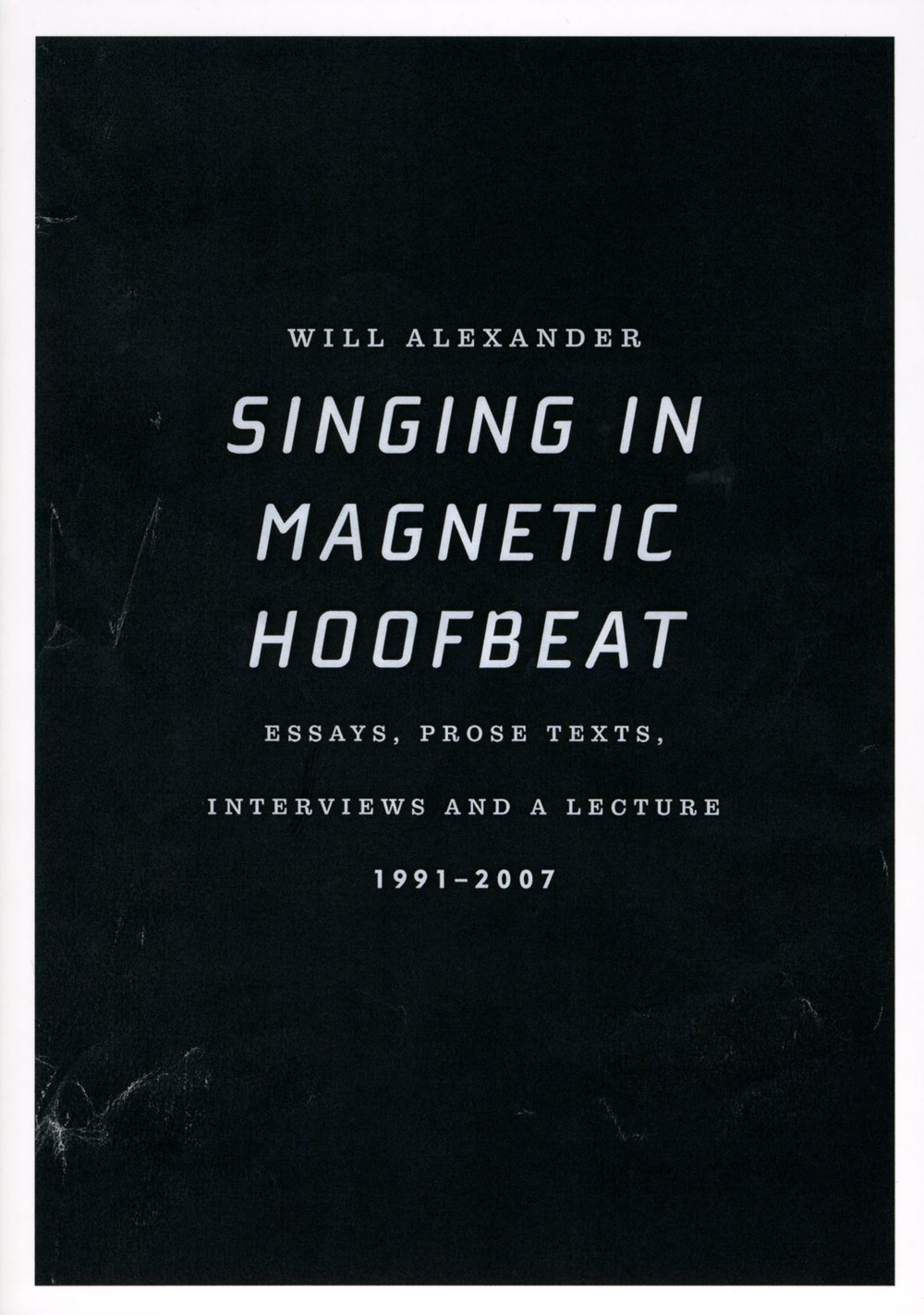
Singing in Magnetic Hoofbeat: Essays, Prose Texts, Interviews and a Lecture 1991-2007
A collection of essays, prose, interviews, and a lecture that moves across surrealism, postcolonial history, and intellectual history. It foregrounds an attempt to expand the essay form itself.
Work Information
A laboratory of thought that expands what the essay can do.
As a representative prose collection by Will Alexander, the book brings together the poet’s and thinker’s wide-ranging concerns. It is highly abstract, but rewarding for readers who follow the movement of language itself.
Book Information
- Publisher
- Essay Pr
- Published
- 2013-04-16
- Pages
- 269 pages
- Language
- 英語
- Size
- 15.88 x 1.91 x 22.23 cm
- ISBN-13
- 9780979118975
- ISBN-10
- 0979118972
- Category
- 洋書/Politics & Social Sciences/Social Sciences/Specific Demographics/African American Studies
Literary Nonfiction. African American Studies. Edited and with an Introduction by Taylor Brady. Afterword by Andrew Joron. One of the most prolific and original figures in the field of contemporary literature, Will Alexander is known worldwide for his arresting explorations of European and Caribbean surrealism, postcolonial history, twentieth-century philosophy, and contemporary scientific theory. Here, Alexander undertakes nothing less than a redefinition of the essay form itself, opening an "artery of twilight" wherein aesthetic, political, historical, social, cultural, scientific, and theoretical discourses often become indistinguishable elements of a holistic investigation into the composition—or, re-composition—of the physical and metaphysical worlds. SINGING IN MAGNETIC HOOFBEAT is an indispensible record of Alexander's thought, and confirms his reputation as one of the foremost exponents of Afro-futurist modernism. "In SINGING IN MAGNETIC HOOFBEAT...Alexander praises his influences; analyzes the politics and aesthetics of the long 20th century; reflects on the repressed, but undeniable importance of African cosmological views to the European Renaissance; and articulates the expansive possibilities of what we might call—non-exclusively—an African diasporic surrealism. For a trail guide to the wonders of Alexandrian poetics, read these essays. For fresh evidence that surrealism is alive, not as a 'movement,' but as a freedom-oriented, imaginatively unbounded mode of being in the world, read these esssays."—Evie Shockley
Reviews
-
Not the Usual Alexander Jaw Droppers
I have been mesmerized by Will's work since I first encountered it in 1980 in one of my professor's literary journals, Nate Mackey's Hambone. I asked Nate about Will, rather furtively mentioned to him i was completely blown away by the ALexander piece and nate gave me a knowing nod like, "Yeah, I hear you, that stuff is IT man!" Nate said to me too, something to the effect of "And can you guess what he does for a living?" I had wondered if such a writer was not so out there, not to mention dedicated that he didn't work or teach or any of the usual. "No, he works, he has a day job believe it or not. At a paper factory of all places!" We had a laugh about such a writer as Will looking at enormous rolls of blank paper all day. But, Letters to Rosa in Hambone 2 was the prose/epistolary I hoped in vain for years would materialize in the form of a book at some point but never did. For me that still epitomizes the ideal Alexander, a melding of the deep psychic fireworks of his poetry with a cohesive narrative/narratives and incredibly intriguing narrators speaking in some kin diof vocabulary more informed by frequent visits perhaps to some ayahuasca induced parallel reality than this one. Diary as Sin, a novel, while another incredible work by Alexander subsumes the solar magnetic ferocity of his poetry in telling a good story. That one also was disappointing to me, yet still also phenomenal writing. There was flashes of a Letters to Rosa type thing in short prose works from the poetry collection, Impulse and Nothingness, poetic prose to make you feel like you are on 400 ugs of LSD such as The Cryptographic Ocelot and Sumatran Mirror World. And it was mostly inspired by the hope that there might be prose written in Alexander's characteristically charged poetic vocabulary of the sort I encountered first in his Letters to Rosa that I shelled out my few remaining shekels one day to order a copy of Singing in Magnetic Hoofbeat sight unseen. I have to say again I was rather disappointed, the elevation of the language never gets above say a Village Voice record review and to be honest, after 5 years of owning a copy of this book, I have not been moved to pick up where i left off, about one third of the way through and consider it more a reference work should I ever decide to write about Alexander's work which I feel uninspired to do -not because of Will's work but because of the incredibly sad state of literature in 2024 as a kind of supply of ammunition for Cultural Marxists and feminists, I mean who cares if that's your only audience, who would want to write for those people apart from themselves. Contrast that with say how I feel about Will's trilogy Kaleidoscopic Omniscience, which i have probably read 7 or 8 times in the last 5 years, and no sign yet that I will tire of reading it, its a new experience every time I pick it up. I only mention all of this as an apology, an apology in the event I have missed something, that in fact there are prose poems in Magnetic Hoofbeat even the rest of Letters to Rosa.But the first third of the book tells you not likely and it all borders on the kind of work you need to do to maintain a professorship, which it would be wonderful if Will has been able to do, I hope so, I imagine he would be just the kind of professor i would be sure and sit in on all of his classes, his literary works carry that level of fascination for me. That alone makes me more than happy I own a copy of Hoofbeat.