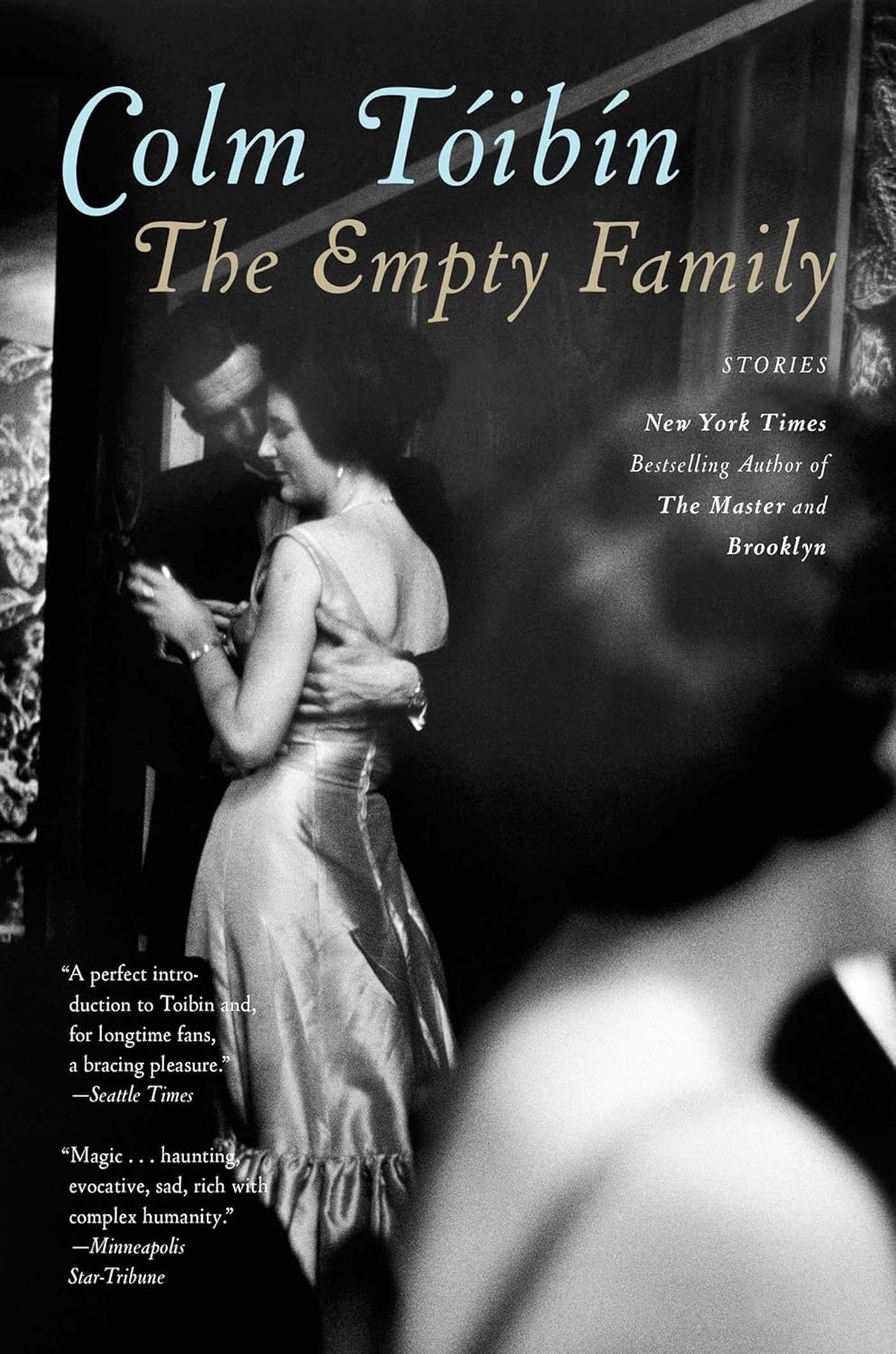
The Empty Family (Bestselling Short Stories)
A short story collection that traces return, loss, and desire across Ireland and Spain. It captures the ache that remains when people try to go back to the past, along with the loneliness that resists easy language.
Work Information
A short story collection where return and loss quietly echo each other.
Colm Tóibín's The Empty Family is a collection of short stories about family, love, and the feeling of return. Centered largely on contemporary Ireland, it renders the solitude of people burdened by memory, including Pakistani workers in Barcelona and characters still haunted by the past.
Review Summaries
-
Its restrained prose and lingering emotional aftertaste are widely appreciated. At the same time, some readers feel the stories vary in intensity and leave uneven impressions.
Book Information
- Publisher
- Scribner
- Published
- 2012-01-03
- Pages
- 288 pages
- Language
- 英語
- Size
- 13.34 x 2.03 x 20.32 cm
- ISBN-13
- 9781439195963
- ISBN-10
- 9781439195963
- Price
- 3151 JPY
- Category
- 洋書/Gay & Lesbian/Literature & Fiction/Fiction/Gay
The bestselling and award-winning author of Brooklyn , Colm Tóibín, returns with a stunning collection of stories—“a book that’s both a perfect introduction to Tóibín and, for longtime fans, a bracing pleasure” ( The Seattle Times ). Critics praised Brooklyn as a “beautifully rendered portrait of Brooklyn and provincial Ireland in the 1950s.” In The Empty Family , Tóibín has extended his imagination further, offering an incredible range of periods and characters—people linked by love, loneliness, desire—“the unvarying dilemmas of the human heart” ( The Observer , London). In the breathtaking long story “The Street,” Tóibín imagines a relationship between Pakistani workers in Barcelona—a taboo affair in a community ruled by obedience and silence. In “Two Women,” an eminent and taciturn Irish set designer takes a job in her homeland and must confront emotions she has long repressed. “Silence” is a brilliant historical set piece about Lady Gregory, who tells the writer Henry James a confessional story at a dinner party. The Empty Family will further cement Tóibín’s status as “his generation’s most gifted writer of love’s complicated, contradictory power” ( Los Angeles Times ).
Colm Tóibín is the author of eleven novels, including Long Island , an Oprah’s Book Club Pick; The Magician , winner of the Rathbones Folio Prize; The Master , winner of the Los Angeles Times Book Prize; Brooklyn , winner of the Costa Book Award; and Nora Webster, winner of the Hawthornden Prize, as well as three story collections and several books of criticism. He is the Irene and Sidney B. Silverman Professor of the Humanities at Columbia University and was named the 2022–2024 Laureate for Irish Fiction by the Arts Council of Ireland. In 2021, he was awarded the David Cohen Prize for Literature.
Reviews
-
The Power of Colm Tóibín's Prose
THE EMPTY ROOM is a priceless collection of short stories from the brilliant author Colm Tóibín. It could be easily said that once hooked on Tóibín's writing the bond is permanent. This exquisite collection is a series of indecisive moments in the lives of folk who are well into middle life, shackled between remembered emotion and the inevitable aging tranquility that is their future. He creates a panorama of characters about whom we come to know and with whom we empathize, but at the same time these created people are laid out on the near-necropsy postmortem table for us to touch and examine and step away. The nine stories included in this volume include 'Silence', a story transplanted to another time in which a Lady Gregory, an abandoned widow who has lost her recent lover, has a peppery dinner conversation with Henry James. In 'The New Spain', 'exiles return to bury loved ones, and ruminate on what other past associates might be up to. A Leftist dissident from Franco's Spain comes back home to a cool reception at the family villa in Menorca.' 'The Pearl Fishers' is a "grim, almost plotless thriller with gay subplots" and "overwrought and graphically violent screenplays." Our hero is invited to have dinner with a married couple, a man named Donnacha and a woman named Grainne, both of whom he has known since they were at school together decades earlier. The two boys (as they were then) were lovers before Donnacha linked up with the fiery, strong-willed Grainne, a religious reformer who has gained some notoriety by insisting "that she and other like-minded lay people represented the true Catholic Church more than the bishops and priests." Much of what we read in The Empty Family is Tóibín's apparent obsessive interest in 'the principal torments available to the educated, Left-leaning, upwardly mobile, male baby boomer in middle age. The men and women who brought us up, and bustled us off to the good schools they never got to attend, will weaken and die, and our professional success won't help them or us deal with that.' For this reader the most compelling story is the very genteel love story represented in 'The Street' - a tale of Pakistani immigrants in Barcelona who somehow survive the threat of being outsiders and in the case of Malik and Abdul discover their same sex needs and find some fulfillment despite the narrow confines of living in a hostile world. Colm Tóibín is a Master Craftsman, a wordsmith without peer, and everything he touches radiates a magic that only he is capable of transforming ordinary lives into extraordinary experiences for the reader. This, then, is literary genius. Grady Harp, September 11
-
Good variety of stories.
Good variety of stories, tho not being gay, I did get a bit tired of one or two stories. However, I think Toibin is a brilliant writer.
-
Brilliant!
I really enjoyed it, just as much as I usually enjoy everything Colm Tóibin writes. If you've missed it, get it now.
-
Moving short stories
Excellent read
-
Love Ceaselessly Beckons
In a hyper-connected world, where friends, family, and even people we hardly know are only a text, Skype, email, Poke, Tweet, Re-tweet, IM, or call away, there is something about willed isolation, the desire to remain cut-off and removed from the heartbeat of anything resembling a loving community that is all the more chilling. Colm Toibin, in this collection of short fiction, has managed a masterful array of stories, and a collage of characters that unveil with melancholic ardor the pain, loss, and empty hearts of people who have refused, run away from, or been denied love. Love lingers in their lives like an open wound, borne from an encounter decades ago. Toibin- like with "Brooklyn" and "The Master" - in these works displays deft restraint. His prose is terse and powerful. His characters' pain is the simple product of a series of wrong turns- that combined and compounded into something more. Central to almost every character in these stories is a lack of reconciliation with the past. Toibin's characters are running- from pain, love lost, truth, loneliness, confusion, time. With each passing decade, the onion adds layers. Toibin gives readers of "The Empty Family" first the mature, ripe onion- followed by a series of glimpses into its core. In this way, the structure of Toibin's stories mimic the rhythm and construction of memory. Nothing is more detailed than now. But the emotion of the past, we cannot escape. The impact of moments, whose importance only grow with age, become more clear, and sometimes painful, in the repeating now. The past emerges to the surface like the first, petite bubbles in a pot of stovetop water that is about to turn over into a violent boil. Frances, in "Two Women", is in the twilight of her life and career. She is a woman "that did not allow herself to feel pain." Frances, on a trip for work to Ireland, is reminded of her 12-year love affair with a man named Luke. "Besides her career, nothing interested her now except her house and her own mind." But for Frances, like so many characters in these stories, the house and mind are not a place of growth and expansion, but rather of retreat. It is a place Frances goes to hide. She resigns from the vulnerability of love in the familiar and routine machinations of her work. Luke was a big decision in her life that she fumbled; and now it haunts her. Through the pain and loss that Toibin orchestrates with the touch of a puppeteer in these stories, through the absence of love, we are given perhaps the most powerful testament of its presence. Love ceaselessly beckons through the void. "The Empty Family" unveils, in all its subtle splendors, this tug of war between the safeness and isolation of a life without love versus the allure and vulnerability of one where love is present. Toibin offers us a powerful portrait of the ruinous effects of a hardened heart on the soul; and in so doing, champions the importance of an open and ever mindful heart.