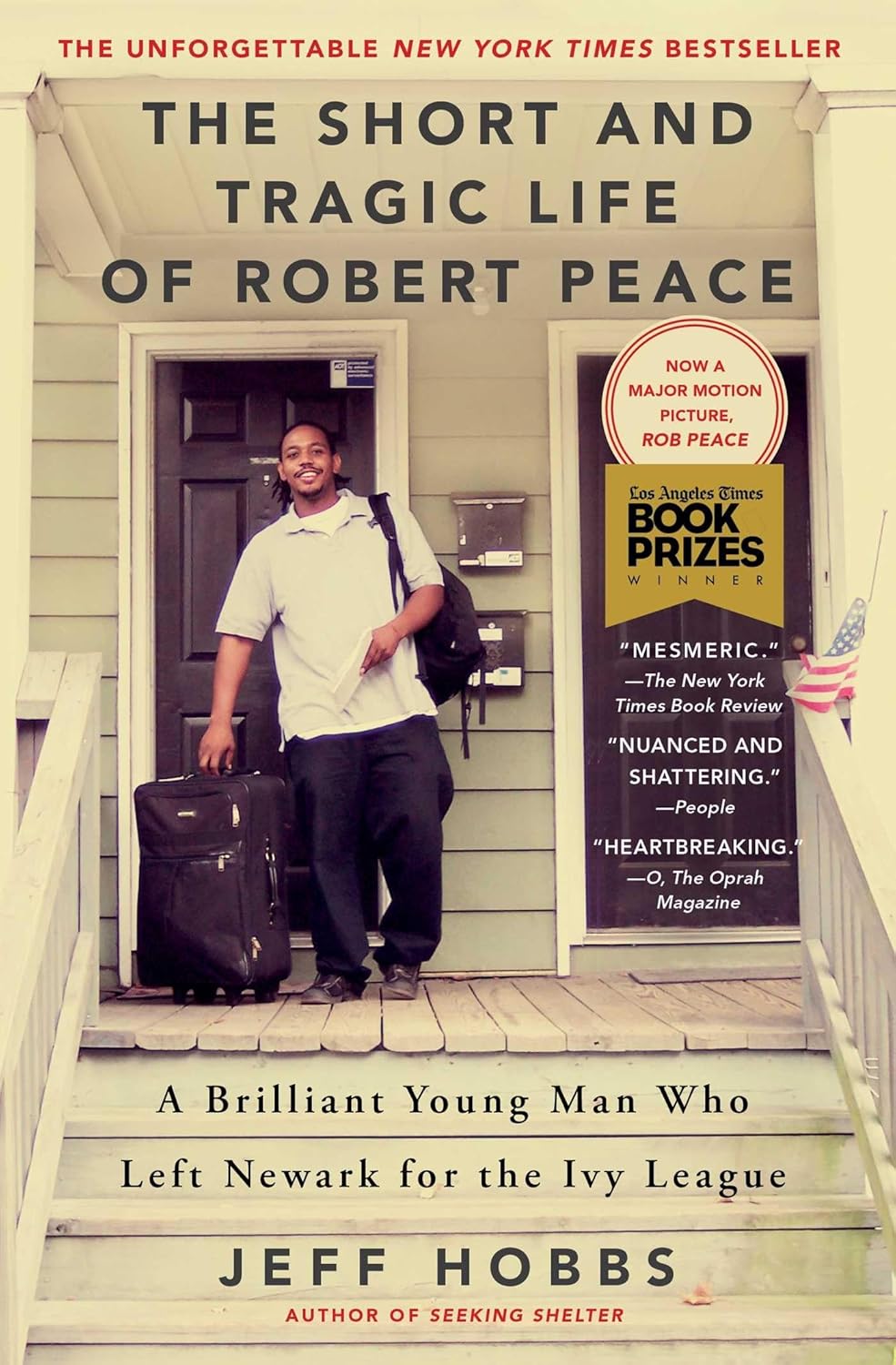
The Short and Tragic Life of Robert Peace: A Brilliant Young Man Who Left Newark for the Ivy League
A nonfiction portrait of Robert Peace’s talent, ambitions, and tragic decline.
Work Information
The book follows a young man from Newark to the Ivy League and traces his life through a friend’s perspective.
Book Information
- Publisher
- Scribner
- Published
- 2015-07-28
- Pages
- 448 pages
- Language
- 英語
- Size
- 13.97 x 2.84 x 21.29 cm
- ISBN-13
- 9781476731919
- ISBN-10
- 1476731918
- Price
- 3154 JPY
- Category
- 洋書/Politics & Social Sciences/Social Sciences/Specific Demographics/African American Studies
An instant New York Times bestseller, named a best book of the year by The New York Times Book Review , Amazon, and Entertainment Weekly, among others, this celebrated account of a young African-American man who escaped Newark, NJ, to attend Yale, but still faced the dangers of the streets when he returned is, “nuanced and shattering” ( People ) and “mesmeric” ( The New York Times Book Review ). When author Jeff Hobbs arrived at Yale University, he became fast friends with the man who would be his college roommate for four years, Robert Peace. Robert’s life was rough from the beginning in the crime-ridden streets of Newark in the 1980s, with his father in jail and his mother earning less than $15,000 a year. But Robert was a brilliant student, and it was supposed to get easier when he was accepted to Yale, where he studied molecular biochemistry and biophysics. But it didn’t get easier. Robert carried with him the difficult dual nature of his existence, trying to fit in at Yale, and at home on breaks. A compelling and honest portrait of Robert’s relationships—with his struggling mother, with his incarcerated father, with his teachers and friends— The Short and Tragic Life of Robert Peace encompasses the most enduring conflicts in America: race, class, drugs, community, imprisonment, education, family, friendship, and love. It’s about the collision of two fiercely insular worlds—the ivy-covered campus of Yale University and the slums of Newark, New Jersey, and the difficulty of going from one to the other and then back again. It’s about trying to live a decent life in America. But most all this “fresh, compelling” ( The Washington Post ) story is about the tragic life of one singular brilliant young man. His end, a violent one, is heartbreaking and powerful and “a haunting American tragedy for our times” ( Entertainment Weekly ).
Jeff Hobbs is the New York Times bestselling author of The Short and Tragic Life of Robert Peace , which won the Los Angeles Times Book Prize, was a finalist for the Pen/Faulkner Award in Biography, was a finalist for the Carnegie Medal in nonfiction, and was made into the 2024 film Rob Peace. He is also the author of Show Them You’re Good and Children of the State . He lives in Los Angeles with his family.
Reviews
-
thought-provoking in turbulent times
Didn't have any expectations when I picked it up. But, the writer's style pulls you into Robert Peace's life succinctly and emotionally. I had to read it in sections, to be able to think about all of the different levels of Peace's life. Well-worth the time and money to see life in the US from another perspective.
-
Tragic must read story
Such a tragic story. I found the book a little hard going at times but in so glad I stuck with it. Such a heartbreaking story but definitely a must read
-
Perfeito
Leitura maravilhosa!
-
Purchased to read for a class but excellent and engaging book
Purchased to read for a class but excellent and engaging book. Very powerful story that addresses many other larger issues.
-
Well written
Sad
-
Moving tale of a young man who went from the streets of Newark to Yale University and struggled to reconcile both worlds
The author, a writer from an upper-middle class, white, third generation Yale family, presents a detailed and intimate portrait of his Yale roommate, Robert Peace, who came from the opposite side of the socioeconomic spectrum - a poor black fractured family - and was the first in his family to go to any college, let alone the Ivy League. Through an amazing feat of research and empathetic depiction, Hobbs gives us a compelling narrative of Peace's childhood and youth, his time at Yale, and his difficulties after graduation as he struggles, despite a brilliant academic record in biochemical research, to figure out what he wants to do next and how to move on with his life without leaving the people he loves in his old neighborhood - his mother, his father, close friends and extended family - behind. You already know from the title that things will not end well, but you become very caught up in the story of exactly how that will play out. And, on a broader plane, you are made aware in a very visceral and thought-provoking way of how profoundly different it is for an affluent WASP like the author to go to a prestigious college and embark on adulthood than for an impoverished African-American or immigrant youth who, at a place like Yale, is in so many ways a fish out of water. If I had stopped two thirds or so of the way through the book, I would have definitely given it five stars. But I've subtracted one because by the end 1) I thought it was just too long - it would have been more powerful if it had been edited down, leaving out parts that seemed peripheral, 2) I felt that Hobbs needed to wrestle more than he did (which was very little) with the nature of his own relationship to Peace - was he drawn to him because to some extent it was a form of "slumming" or because it gave him more "cred"? Was it in any sense a form of exploitation for Hobbs to write this book rather than, as he seems to want you to believe, a commendable effort to celebrate his former roommate? and 3) although I appreciated Hobbs' decision to show the reader Peace's life rather than to spend a lot of time interpreting or analyzing it, at the end I felt there did need to be some speculation on the author's part about why things ended up the way they did. He hints at the reasons, but I would have preferred him to use his first hand knowledge of Peace to draw some conclusions, even if acknowledging that he would never know for sure. So, a book well worth reading, but just short of totally satisfying.