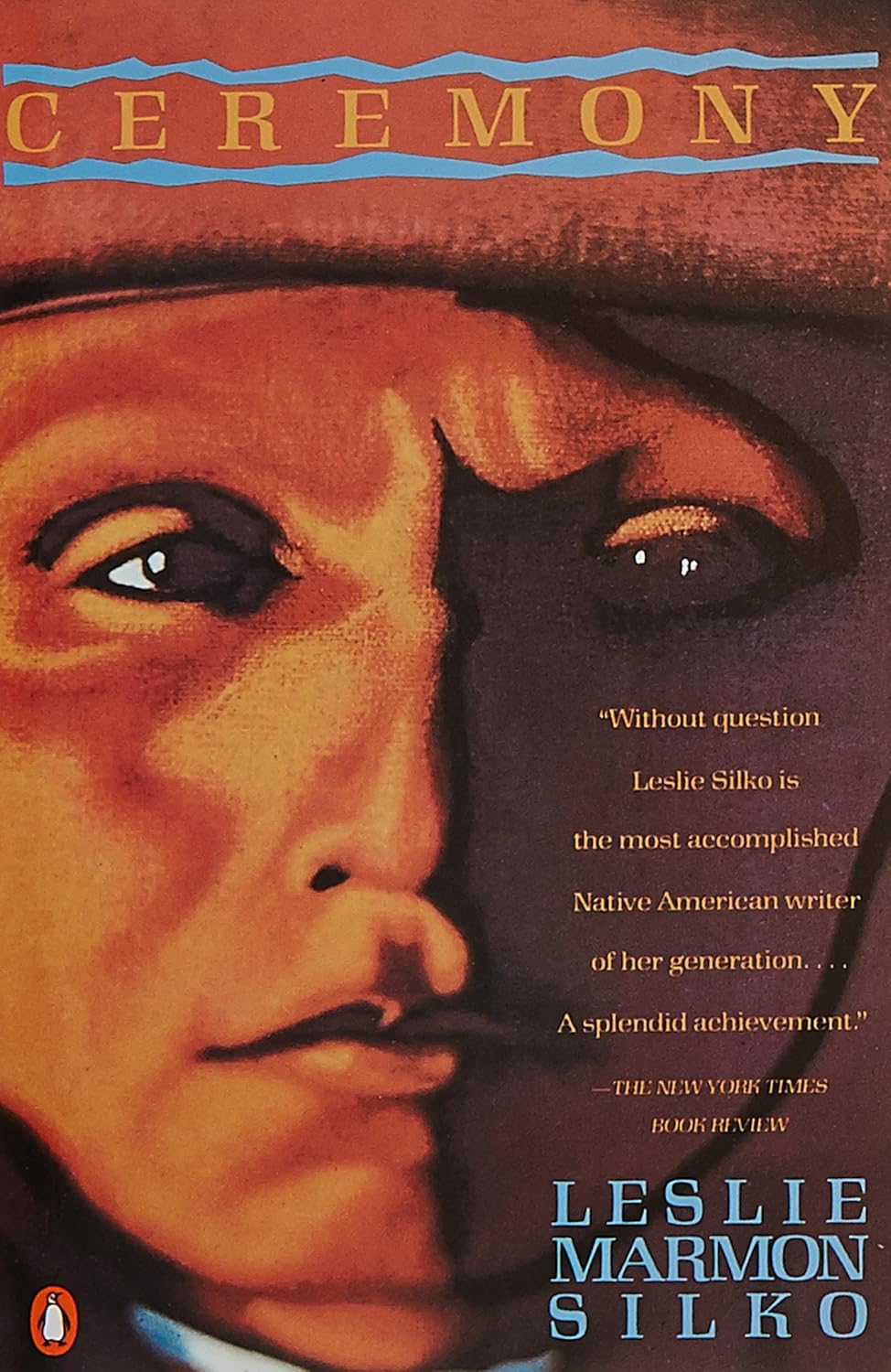
Ceremony (Contemporary American Fiction Series)
A novel centered on Tayo, a returning World War II veteran, that interweaves Native tradition with a fragmented modern world to explore healing and renewal, with cultural memory and ceremony at its core.
Work Information
Story and ceremony slowly stitch together a damaged sense of time.
Leslie Marmon Silko’s landmark novel follows a young returning veteran marked by war and quietly shows how community memory, land, and ceremony can restore life.
Book Information
- Publisher
- Penguin Books
- Published
- 1986-03-04
- Pages
- 272 pages
- Language
- 英語
- Size
- 12.88 x 1.12 x 19.61 cm
- ISBN-13
- 9780140086836
- ISBN-10
- 0140086838
- Price
- 2028 JPY
- Category
- 洋書/Politics & Social Sciences/Social Sciences/Specific Demographics/Native American Studies
Tayo, a young Native American, has been a prisoner of the Japanese during World War II, and the horrors of captivity have almost eroded his will to survive. His return to the Laguna Pueblo reservation only increases his feeling of estrangement and alienation. While other returning soldiers find easy refuge in alcohol and senseless violence, Tayo searches for another kind of comfort and resolution. Tayo's quest leads him back to the Indian past and its traditions, to beliefs about witchcraft and evil, and to the ancient stories of his people. The search itself becomes a ritual, a curative ceremny that defeats the most virulent of afflictions—despair.
Leslie Marmon Silko was born in 1948 to a family whose ancestry includes Mexican, Laguna Indian, and European forebears. She has said that her writing has at its core “the attempt to identify what it is to be a half-breed or mixed-blood person.” As she grew up on the Laguna Pueblo Reservation, she learned the stories and culture of the Laguna people from her great-grandmother and other female relatives. After receiving her B. A. in English at the University of New Mexico, she enrolled in the University of New Mexico law school but completed only three semesters before deciding that writing and storytelling, not law, were the means by which she could best promote justice. She married John Silko in 1970. Prior to the writing of Ceremony , she published a series of short stories, including “The Man to Send Rain Clouds.” She also authored a volume of poetry, Laguna Woman: Poems , for which she received the Pushcart Prize for Poetry. In 1973, Silko moved to Ketchikan, Alaska, where she wrote Ceremony . Initially conceived as a comic story abut a mother’s attempts to keep her son, a war veteran, away from alcohol, Ceremony gradually transformed into an intricate meditation on mental disturbance, despair, and the power of stories and traditional culture as the keys to self-awareness and, eventually, emotional healing. Having battled depression herself while composing her novel, Silko was later to call her book “a ceremony for staying sane.” Silko has followed the critical success of Ceremony with a series of other novels, including Storyteller, Almanac for the Dead , and Gardens in the Dunes . Nevertheless, it was the singular achievement of Ceremony that first secured her a place among the first rank of Native American novelists. Leslie Marmon Silko now lives on a ranch near Tucson, Arizona.
Reviews
-
Top
-
What an extraordinary story. Poetic, inspired, wise. A work to read and feel again and again, until its lessons soak into the bones.
-
Lecture plaisir, très informatif, surtout émouvant.
-
I loved this book and the central character, Tao, who is the product of a very mixed race background with his "light brown skin and hazel eyes". It lets you enter his world as he returns shattered by the experience of war. While he fights in an American Uniform he is a hero but on returning home without his army dress he is again a non-person. He suffers post-war traumatic stress but there is little or no help for him. He goes to his own native indian ancestors for help in overcoming his problems by their constant telling of native stories and remedies. The book is divided not by formal chapters but poems and wonderful prose passages which are a joy to read. I truly enjoyed this book and would recommend it to anyone. Christine Harris
-
They fear They fear the world. They destroy what they fear. Tayo, having been released from a Japanese prison camp and then a hospital in the United States, is “tired of fighting off the dreams and the voices; he was tired of guarding himself against places and things which evoked the memories.” Suffering from “battle fatigue” (what would be referred to as post-traumatic stress disorder today), Tayo determines his only chance at renewal is in the return to his home, the Laguna Reservation in the New Mexico. There he hopes the people he long has known, their customs and traditions, and the familiar environment will cure his ills which also include the death of his cousin during the war and his uncle’s death while Tayo was away. But it is not to a paradise that the approximately twenty-three-year-old, half white/half Native American young man returns. Poverty reigns. The land is arid and of little use, and the abuse and the unabated exploitation of Native American people continues as it has for years. Such is the world the reader enters with Tayo in Leslie Marmo Silko’s first novel, CEREMONY [(1977; 243 pp. in the Penguin Books Anniversary edition (2006) with a New Preface by the author and an Introduction by esteemed western author Larry McMurtry)]. Silko’s novel has been described as a masterpiece of Native American literature. The narrative she creates is rich and complex, demanding the reader’s attention. As her protagonist, Tayo’s story is told in a stream of consciousness style with frequent, sudden flashbacks between WWII, confinement in the prison camp, in hospital after the war, and life on the Laguna Reservation. Adding to the richness of her text are flashbacks to earlier battles Native Americans waged with sorcery and the Whites. Further intricacy is added to the chronicle as Tayo is besieged by voices of the War and from his deceased friends and family. Altogether, it makes for a fascinating portrait of a suffering individual looking for healing and regeneration. Silko’s descriptions of life on and near the reservation are vivid. She vibrantly brings to the pages of the novel the paradoxical harshness of the environment and its unique beauty. Likewise, the beauty and nobility of the Laguna people is contrasted with the severity of their lives which can lead to helplessness, emptiness, and capitulation. Never does she romanticize Native American life or culture nor does she write seeking sympathy. Hers is a very objective and honest approach to her realistic characters and their existence. Interspersed throughout the narrative of CEREMONY is beautiful verse often conveying stories or images which enhance the tale. As CEREMONY progresses, Tayo realizes “his sickness was only part of something larger, and his cure would be found only in something great and inclusive of everything.” He becomes obsessed with a mission: bringing to life his dead uncle’s determination to breed cattle which are hardier and “could survive drought and hard years” in the challenging, infertile conditions of the American Southwest. This also means finding and resecuring cattle stolen by white ranchers—a perilous undertaking. It is at this point in the chronicle in which Silko’s story-telling becomes somewhat more conventional and readers, having come to know Tayo quite fully, become even more involved with his fate and well-being. As Silko brings the worlds of the mystical, the past, and the present of the story, where the “balances and harmonies [are] always shifting,” amazingly CEREMONY speaks to our “fragile” world of today “inside the belly of the wind” and the precipice upon which it teeters between healing and destruction in so many ways. The concluding pages of CEREMONY taking place in “a restless, dry wind that felt as if it blew out of dusty years of the past; [and] …smelled of emptiness and loss” are filled with history, irony, betrayal, death, the discovery of new truths, strength, and fragile hope. Tayo’s journey is a fascinating one—one which the reader will be glad and feel enriched having traveled it with Leslie Marmo Silko.
Related Literary Awards
- American Book Awards Edition 1 (1980) ・Winner