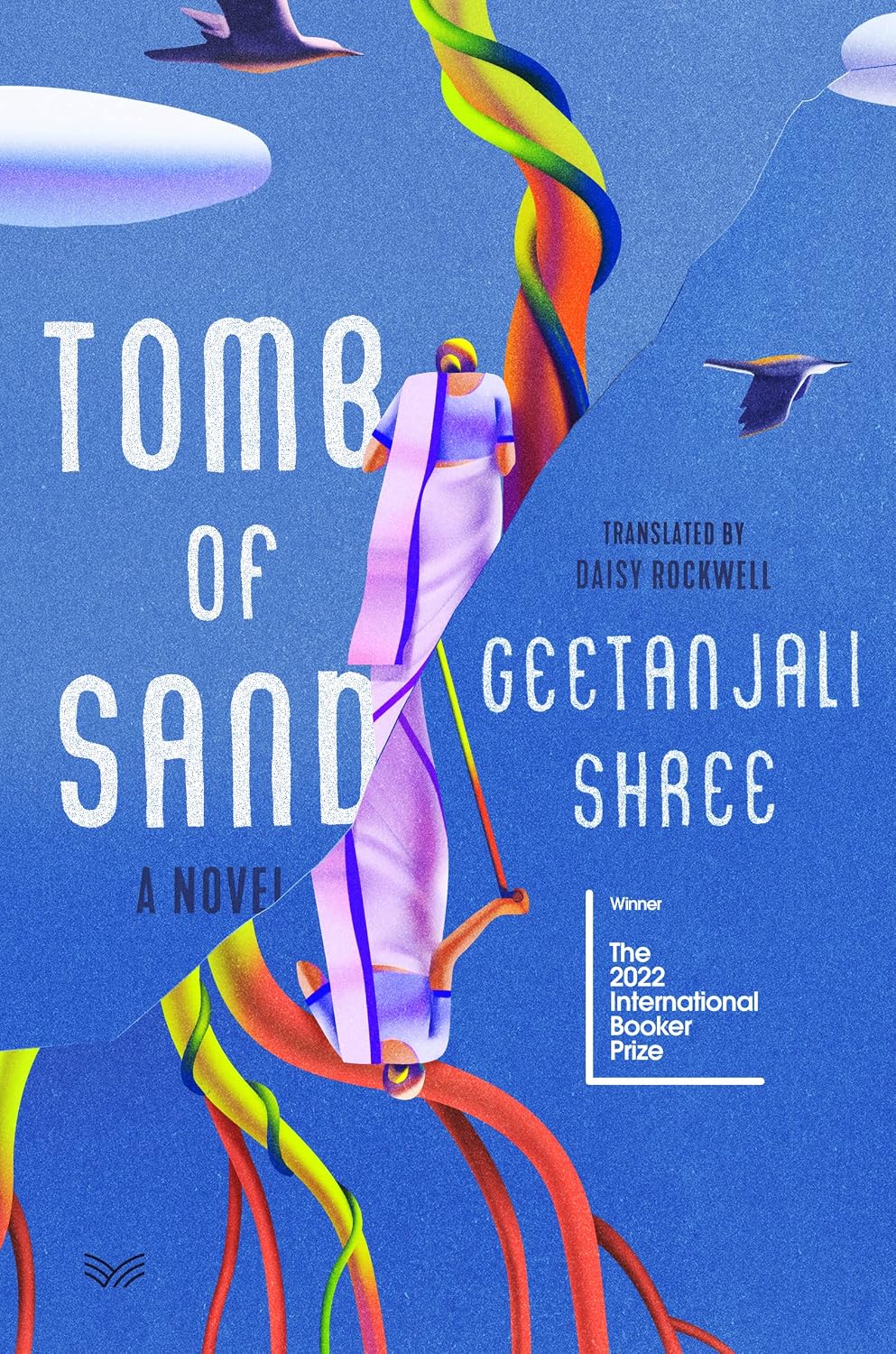
Tomb of Sand: A Novel
Tomb of Sand is a multivoiced novel centered on an elderly woman who begins a new life after her husband's death. It explores family history, Partition memory, and movement across borders with humor and formal experimentation.
Work Information
A novel that expands old age and memory through humor and formal invention.
As the English translation of the Hindi original Ret Samadhi, the book renders overlapping family and historical memory with humor and boldness. Personal renewal and the memory of Partition intertwine over a long, expansive arc.
Book Information
- Publisher
- HarperVia
- Published
- 2023-01-31
- Pages
- 624 pages
- Language
- 英語
- Size
- 15.24 x 3.96 x 22.86 cm
- ISBN-13
- 9780063299405
- ISBN-10
- 0063299402
- Price
- 6016 JPY
- Category
- 洋書/Gay & Lesbian/Literature & Fiction/Fiction/Gay
WINNER OF THE 2022 INTERNATIONAL BOOKER PRIZE "A triumph of literature."—Financial Times "Echoes of James Joyce, Jorge Luis Borges, Isabel Allende and Leo Tolstoy. . . . An enchanting ride."—BookPage "A breath of fresh air."—Guardian A playful, feminist, and utterly original epic of Indian literature in translation, set in contemporary northern India, about a family and the inimitable octogenarian matriarch at its heart. "A tale tells itself. It can be complete, but also incomplete, the way all tales are. This particular tale has a border and women who come and go as they please. Once you’ve got women and a border, a story can write itself . . ." Eighty-year-old Ma slips into a deep depression after the death of her husband, beginning a poignant story of grief and rebirth. Despite her family’s cajoling, she refuses to leave her bed. Her responsible eldest son, Bade, and dutiful, Reebok-sporting daughter-in-law, Bahu, attend to Ma’s every need, while her favorite grandson, the cheerful and gregarious Sid, tries to lift her spirits with his guitar. But it is only after Sid’s younger brother―Serious Son, a young man pathologically incapable of laughing―brings his grandmother a sparkling golden cane covered with butterflies that things begin to change. With a new lease on life thanks to the cane’s seemingly magical powers, Ma gets out of bed and embarks on a series of adventures that baffle even her unconventional feminist daughter, Beti, testing their complex mother-daughter relationship. She ditches her cumbersome saris, develops a close friendship with a hijra, and sets off on a fateful journey that will turn the family’s understanding of themselves upside down. Rich with fantastical elements, folklore, and exuberant wordplay, Geetanjali Shree’s magnificent novel is a masterpiece of magical realism that explores timely and timeless topics, including Buddhism, global warming, feminism, Partition literature, gender binary, transcending borders, and the profound joys of life. Elegant, heartbreaking, and funny, it is a literary masterpiece that marks the American debut of an extraordinary writer. Translated from the Hindi by Daisy Rockwell Author’s name pronounced: Ghee-TAHN-juh-lee Shree
Geetanjali Shree is the author of five novels, including Tomb of Sand for which she was awarded the 2022 International Booker Prize, and five story collections. Her work has been translated into several European and South Asian languages, and has received numerous accolades. She lives in New Delhi, India. Daisy Rockwell is a painter, writer, and translator living in Vermont who was awarded the International Booker Prize in 2022 for her translation of Geetanjali Shree's Tomb of Sand . She has also translated a number of classic works of Hindi and Urdu literature, and in 2019 she was awarded the Modern Language Association’s Aldo and Jeanne Scaglione Prize for her translation of Krishna Sobti’s A Gujarat Here, a Gujarat There .
Reviews
-
Ponderous and somewhat elusive story
Despite its woke acclamations, I found this book ponderous, over clever and a bit of a struggle. It is full of word play, jokes, fantasies and whimsical reflections by the author(s). Although translated, and the translator seems to have had almost as much input as the original Hindi written version by expanding the text to make the English version of puns and word-play actually work, this very long book also requires that the readers know a great deal about Hindi language, culture and deities if they are to ‘get it’. The book is about an Indian family’s intimate life and eventually the oldest woman’s journey with her daughter to places of memories of her past life. Maybe it is about the absurdity of borders but this seems somewhat pretentious.
-
As described!
Book was as described!
-
Did not live up to expectations
The book did not live up to expectations
-
A border-bending work of fiction.
With Tomb of Sand, Geetanjali Shree claims space among the Partition writers she so vividly pays her dues to. Because as with the best literature, it speaks most urgently to the present. The narrative follows the odyssey of an 80-year-old woman named Ma, whose world is clouded by grief following her husband’s demise. Motivated by an inner resolve, she finally restarts her interactions with the world, especially with a transgender woman named Rosie. Bade and Beti are bewildered by their mother’s new-found enthusiasm for life. Ma’s descent into profound depression after her husband’s passing is contrasted with her eventual resurgence and fervent embrace of a newfound vitality. After having lived most of her life on the terms dictated by others, a motivated Ma embarks on a poignant journey to Pakistan, aiming to confront and reconcile the lingering scars of her teenage survival during the Partition riots. It is an immersive novel that delves into the complexities of human relationships and the lingering influence of the past on the present. It also talks about the limits society places on us and we ourselves get so used to living within our bounds that we don’t question it. We get used to these limits and divisions based on irrelevant factors. Ma goes into depression after her husband dies and refuses to even turn her face from the wall she faces everyday. It’s what most Indian women would feel, who are raised to be just wives and mothers. When those duties are done, they are lost and don’t know how to live for themselves. We also see the family dynamics, where the elder son feels he is the Man of the House and should be responsible for taking care of his mother, and takes pride in it. When Ma shifts with her independent daughter, it is she who feels that she is the better child for it is in her house that Ma has started taking interest in life once again. However, she also feels stifled with that responsibility. Geetanjali’s writing is almost poetic at times. The way she describes the sun following Ma in the day makes you feel warm and cosy. She also casually throws in deep truths like: “Why are the only correct answers the ones you know?” or “You go where poverty takes you.” The author doesn’t shy away from raising issues of government inadequacies and mentions various actual incidents that happen in the story’s timeline as if they’re mere distractions. Geetanjali has sewed together many different themes into a beautiful blanket. However, as I mentioned earlier, it can try your patience at times. I took my time reading it, and got back to it when I had the patience to enjoy reading it and not just find out what happens next. A lot of the story is non-linear and often seems to drift off on a tangent, but then she brings you back where you started and things make sense again. I would say the book is a Must-Read, not just for the story but also the story-telling, but I also understand not everyone will survive till the end. Verdict: A Must Read
-
Love the book
A very nice read