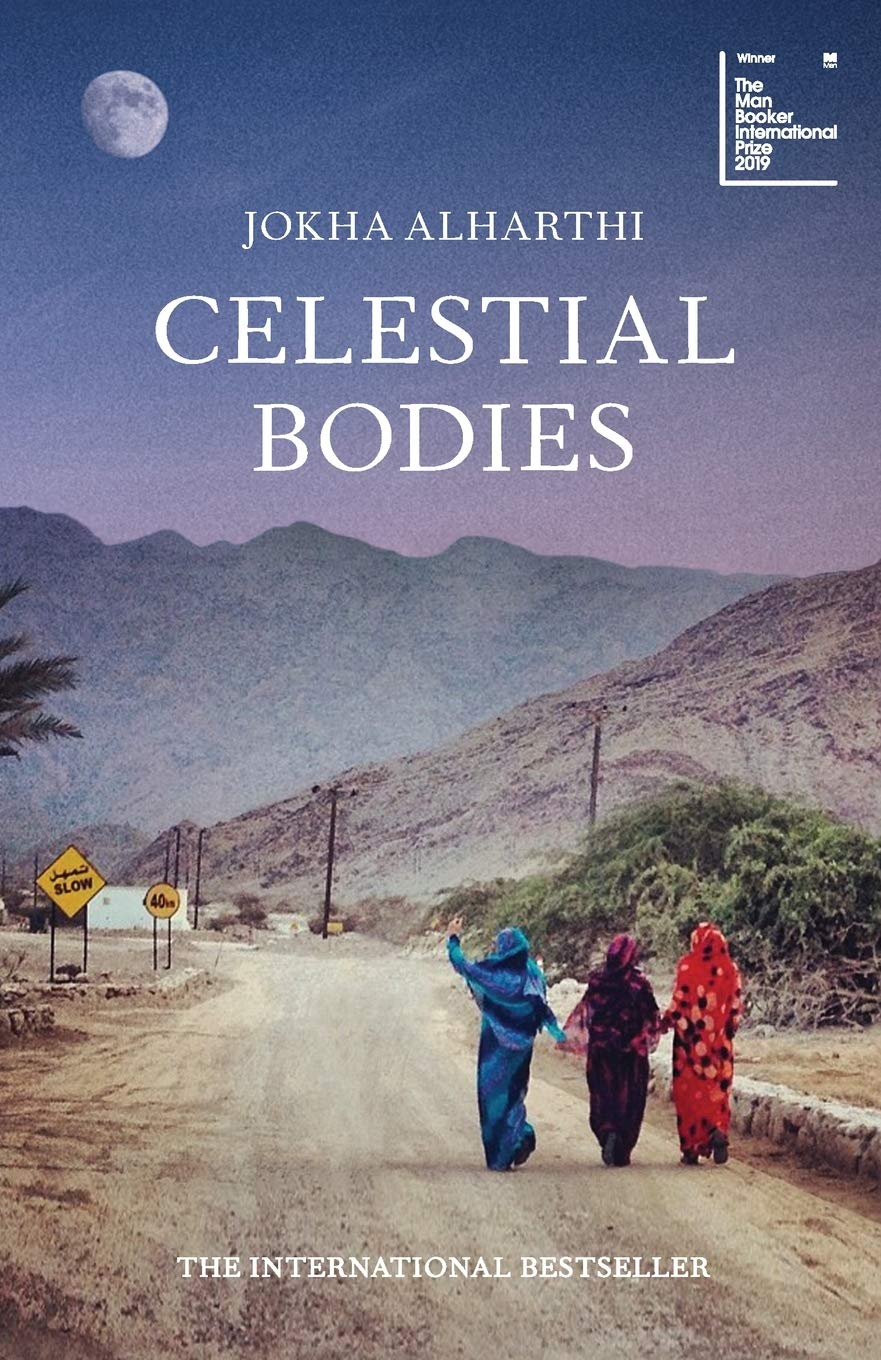
Celestial Bodies
An Omani family novel that traces women, marriage, and social change across generations.
Work Information
An Omani family novel that traces women, marriage, and social change across generations.
An Omani family novel that traces women, marriage, and social change across generations.
Book Information
- Publisher
- Sandstone Press
- Published
- 2018-06-21
- Pages
- 256 pages
- Language
- 英語
- Size
- 13.34 x 2.54 x 19.69 cm
- ISBN-13
- 9781912240166
- ISBN-10
- 1912240165
- Price
- 2127 JPY
- Category
- 洋書/Literature & Fiction/Contemporary
Celestial Bodies is set in the village of al-Awafi in Oman, where we encounter three sisters: Mayya, who marries Abdallah after a heartbreak; Asma, who marries from a sense of duty; and Khawla who rejects all offers while waiting for her beloved, who has emigrated to Canada. These three women and their families witness Oman evolve from a traditional, slave-owning society slowly redefining itself after the colonial era, to the crossroads of its complex present. Elegantly structured and taut, Celestial Bodies is a coiled spring of a novel, telling of Oman’s coming-of-age through the prism of one family’s losses and loves.
Jokha Alharthi is the author of two previous collections of short fiction, a children’s book, and three novels in Arabic. Fluent in English, she completed a PhD in Classical Arabic Poetry in Edinburgh, and teaches at Sultan Qaboos University in Muscat. She has been shortlisted for the Sahikh Zayed Award for Young Writers and her short stories have been published in English, German, Italian, Korean, and Serbian.
Reviews
-
My initial delight that an Omani writer Jokha Alharthi and her translator Marilyn Booth had won this year’s Man Booker International prize for ‘Celestial Bodies’ was somewhat tempered when I set about reading the novel. If I were not an ‘Omanophile’, and someone who worked in the Sultanate throughout the 1980s, the period portrayed in much of the book, I doubt if I would have persevered to the end of this relatively short novel. In the end I am glad that I did, however, because luckily a number of incidents mentioned in the text became clear in the last 50 pages, such as the circumstances surrounding the death of Abdullah’s mother and everyone’s reluctance to talk about it. For me there was a wealth of fascinating cultural information to which as an expatriate in Oman, particularly a male expatriate, I had little or no access, such as the rituals and superstitions involved in births and deaths, life from women’s viewpoint, the ways of appeasing the djinns, and so on. Sadly, though, by the time I reached the end the damage had already been done as regards my appraisal of the novel as a worthy winner of the prize. I would like to say that the structure was just too radical or too erudite for me to handle; but it was simply that far too much effort was expended on trying to work out the order of events, who was who, and so on. Even when I reached the end, I was still constantly checking the family tree. Without this being provided at the beginning of the book, it would have been quite impossible to fathom out all the family relationships. Frankly, a really good short novel should be able to stand on its own without such vital support material. Adding to the confusion was an almost total absence of dates in the text – and with constant flitting between different periods and places of the characters’ lives, a few more dates would have been extremely helpful. There were pages where I was struggling to see which period, and even sometimes which person, was being referred to. The use of pronouns in particular created ambiguities and left me very confused in places, but as my Arabic is not good enough to read the original, I cannot say how much of this was due to the translation. The total absence of quotation marks in the book, while it may be a fashionable device and undoubtedly makes life easier for proof-readers, did not enhance the clarity of the translation, either. On the other hand, I did enjoy much of the language and particularly the poetic sections, with quotations from Arab poets, on the influence of the moon, the planets and the stars: ‘Of all the celestial bodies, the moon is closest to the matters of this lower world. And so it is a guide to all things…..’ (p.217). There is certainly plenty in these sections to stimulate anyone interested in following up the references to Arab poetry and philosophy. I am sorry that I am not supporting my opinions here with further concrete examples from the text, and a second reading would certainly help me to understand the structure and storyline better. Sadly, life is too short, and because of the difficulties in getting to grips with the book, I really wouldn’t have the energy to read it again. The image of the book which is left in my mind is rather like that of a jigsaw, which is completed and then (deliberately) knocked off the table, scattering all the pieces. The jigsaw has to be reconstructed, but in no particular or logical order of pieces, of course. At the end, a few pieces are, disappointingly, missing – they lie hidden under the carpet. When these are eventually found after a long search, they do indeed fill in the gaps and make the whole picture cohesive, but there is still some sense of disappointment remaining.
-
Pathetic pages.. its like as in very cheap weeklies.. so poor quality.. I never expected a booker winning novel in such cheap pages.. one reading.. the pages are already like worn out..
-
But SO confusing!!! This is a book to sit down and read cover to cover so you don't lose track of who is who, when. It needs total concentration which, perhaps, I didn't have at the time. Having said that, some of the passages are so beautiful it takes your breath away.
-
" ‘Alabado sea Dios que ha bendecido a la humanidad con la capacidad de olvidar’. “Vi a mi padre en mis sueños, con los ojos rojos de tanta ira. Estaba atando una cuerda de fibra de palma en mi cara. ¿Dónde estás ahora, tú y tus gritos en mi cara infantil? ¿Olvidar? ¿Dónde está este lugar llamado Olvidar?" "¿Por qué empezó a hablar de propiedad? Él era el que tenía una familia, hijos, y ella no le exigía nada. Era perfectamente feliz así. No se le ocurrió pensar en cosas como "posesiones" y "cacería". Su deseo era ser su amante y lo era, y no quería nada más. ¿Por qué él siempre parecía tan torturado por sentimientos crípticos que ella no podía comprender?" Una muy buena novela. Fue la ganadora del Premio Booker Internacional (para obras traducidas) 2019.
-
The characters and their stories were very interesting and made for a good read. However, the story was a bit disjointed and jumped between past, present and future in a way that was hard to follow. This copy has no quotation marks to indicate speech, which made it even more difficult to follow. The story had a lot of loose ends and quite a confusing ending.